The Art of Waiting: How Kashmiri Craftspeople Are Redefining Desire in an Age of Instant Everything
There is a particular kind of hunger that fast delivery cannot satisfy. It arrives not in the moment of acquisition, but in the long, expectant interval before it — in the weeks spent imagining a thing, researching its origins, corresponding with its maker. American consumer culture has largely engineered this feeling out of existence. Kashmiri artisans are quietly engineering it back in.
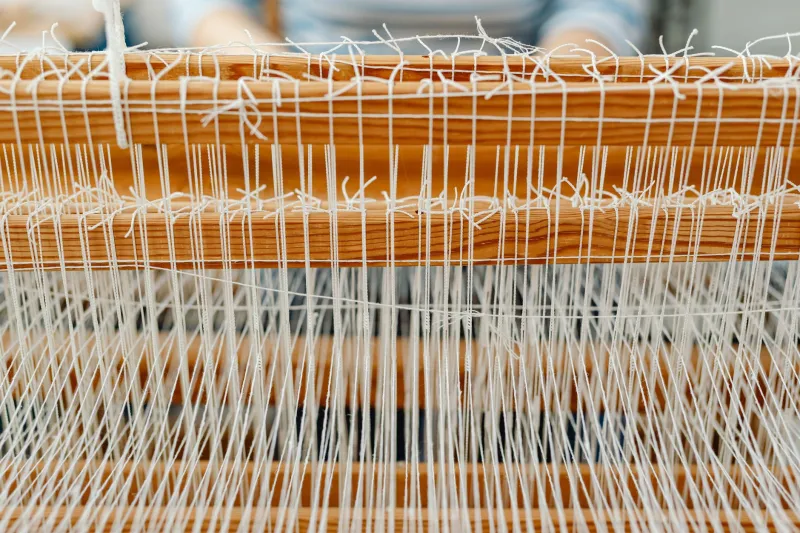
In the workshops and family studios scattered across the Kashmir Valley, production schedules are measured in seasons, not shipping windows. A single kani shawl — woven on a traditional loom using a system of coded pattern sticks — may require a year and a half of daily labor before it is ready to leave its maker's hands. A heavily embroidered sozni piece might circulate among three or four artisans across as many months, each contributing a specific element of a larger design. This is not inefficiency. It is, in the most considered sense, a philosophy.
A Deliberate Refusal
To understand why Kashmiri craftspeople resist acceleration, one must first understand what acceleration would cost them. The techniques that define the region's textile heritage — needle-based tilla embroidery, hand-spun pashmina preparation, the interlocking weft patterns of loom weaving — are not merely slow by circumstance. They are slow by design. Speed would require simplification, and simplification would mean the erasure of the very qualities that distinguish these objects from their machine-made counterparts.
Many master artisans in Kashmir have been approached over the years by commercial interests eager to streamline their output. The answer, more often than not, has been a polite but firm refusal. To these craftspeople, the timeline of creation is inseparable from the integrity of the object. A shawl completed in three weeks is not the same shawl completed in fourteen months — not because the materials differ, but because the accumulated intention does.
This stance places Kashmiri artisans in direct philosophical opposition to the fast-fashion model that dominates global retail. Where that industry prizes throughput, they prize depth. Where it rewards novelty, they cultivate permanence. It is a counterculture built not from protest, but from an unshakeable fidelity to craft.
What Waiting Does to the Collector
For American buyers raised on the dopamine loop of instant gratification — the one-click purchase, the two-day arrival, the unboxing video — the experience of commissioning or awaiting a Kashmiri textile can feel genuinely disorienting at first. And then, often, profoundly restorative.
Psychologists have long noted that anticipation, when attached to something meaningful, is itself a form of pleasure. The interval between desire and fulfillment, rather than being a void to be minimized, can function as a kind of extended savoring. We know this intuitively when we think about travel, or about meals prepared with visible care, or about letters written by hand. The waiting is part of the experience. It is not a delay in the experience.
Collectors who have waited months for a commissioned Kashmiri piece frequently describe the arrival of that object in terms that go well beyond ordinary satisfaction. There is a quality of recognition in it — a sense that the object has been anticipated into existence, that the time spent imagining it has somehow deepened the encounter with the real thing. The shawl or rug or embroidered panel that finally arrives is not merely a product. It is the culmination of a sustained act of attention.
The Commission as Relationship
One dimension of Kashmiri craft culture that American collectors often find unexpected is the degree to which acquiring a piece can become an ongoing correspondence. Many artisans welcome communication during the creation process — sharing progress, explaining design choices, describing the particular challenges a pattern presents. For collectors willing to engage at this level, the experience of ownership begins long before the object arrives.
This relational dimension of acquisition is vanishingly rare in contemporary retail. Most consumer goods arrive as anonymous objects, their histories invisible, their makers unknown. A Kashmiri textile, by contrast, may come with a name attached — a weaver in Kanihama, an embroiderer in Srinagar — and with a correspondence that has unfolded over months. The object carries that history within it, and collectors who understand this find that it fundamentally alters how they relate to what they own.
House of Kashmir has worked with collectors across the United States who describe this shift as one of the more meaningful changes in how they think about acquiring things generally. Once you have waited for something with genuine care, and understood the labor that made it possible, the appeal of frictionless consumption begins to diminish.
Slowness as a Form of Luxury
In a culture where speed is so thoroughly associated with privilege — where premium services exist largely to eliminate waiting — the idea that slowness might itself be luxurious requires a small but significant reorientation. Yet this is precisely what Kashmiri craft tradition proposes.
True luxury, in this framing, is not the elimination of time. It is the investment of it. The most extraordinary textiles produced in Kashmir are extraordinary precisely because they represent an accumulation of hours that no machine can replicate and no shortcut can approximate. The luxury is not in the speed of delivery. It is in the irreplaceable human presence embedded in every stitch, every passage of the shuttle, every decision made by a craftsperson who has spent decades learning to make exactly this kind of object.
For discerning collectors, this distinction matters enormously. A piece that took eighteen months to make will not depreciate in the way that a fast-fashion item depreciates — not because of any formal scarcity, but because the time invested in it is a form of value that cannot be inflated away. It is, in the most literal sense, irreproducible.
Learning to Want Differently
The deeper invitation that Kashmiri craft culture extends to American collectors is not simply to buy slowly, but to want differently. To cultivate the kind of desire that is patient enough to wait, curious enough to learn, and attentive enough to recognize what it finally receives.
This is not a natural posture in a culture engineered around immediacy. It requires practice, and a willingness to resist the low-grade anxiety that instant availability has trained us to feel whenever we cannot have something right now. But the collectors who have made this adjustment — who have learned to sit with wanting, to research and correspond and anticipate — consistently report that the objects they acquire through this process occupy a different category in their lives entirely.
They are not purchases. They are arrivals.
And the waiting, it turns out, was always part of what made them worth having.