The Art of Living with Kashmir: A Designer's Guide to Weaving Himalayan Craftsmanship Into the American Home
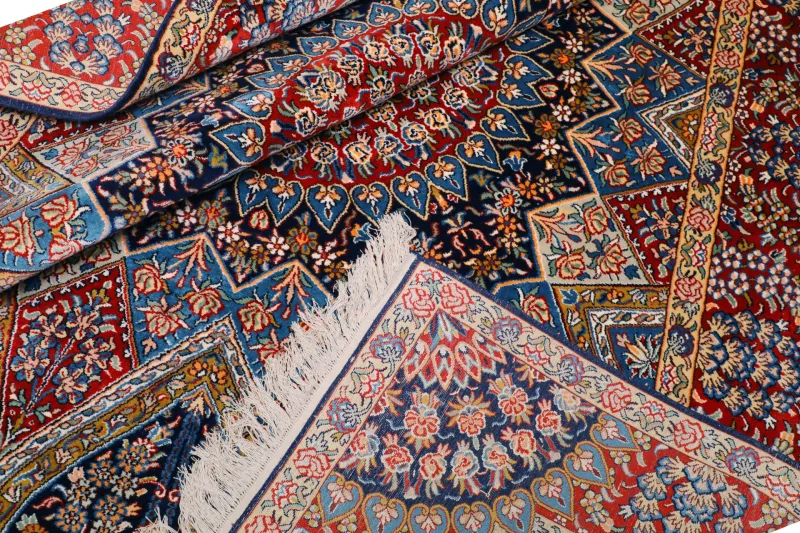
Photo: luxury Kashmiri textiles interior design modern American living room pashmina throw hand-knotted silk rug, via www.mirascrafts.com
The most enduring interiors are never simply decorated — they are composed. They reflect a collector's sensibility, a willingness to look beyond trend cycles toward objects of genuine craft provenance and lasting visual weight. For American homeowners who have arrived at this understanding, Kashmiri artisan textiles offer something the mainstream home goods market rarely provides: pieces that are simultaneously beautiful, culturally resonant, historically significant, and — when chosen with care — genuinely appreciating in value over time.
The following guide, informed by conversations with interior designers who regularly incorporate global craft traditions into residential projects, offers five considered approaches to living with Kashmir.
1. Anchor a Room With a Hand-Knotted Kashmiri Rug
No single design decision carries more consequence in a room than the choice of floor covering. A hand-knotted Kashmiri rug — woven on vertical looms by artisans who may spend eighteen months or more completing a single large-format piece — brings to a space something that no machine-produced rug can approximate: a visual complexity that rewards prolonged attention.
Kashmiri pile rugs, typically woven in silk or a wool-silk blend, are distinguished by their extraordinarily fine knot counts — often exceeding 400 knots per square inch in premium examples — and their characteristic palette of jewel tones: lapis, saffron, emerald, and ivory, frequently arranged in the concentric medallion patterns that have defined the Kashmiri weaving aesthetic for centuries.
In contemporary American interiors, these rugs perform best when given room to breathe. Interior designer Claire Maddox, whose New York-based practice has incorporated South Asian textiles into residential projects ranging from Upper East Side apartments to Santa Barbara estates, recommends treating a fine Kashmiri rug as the room's primary statement. "When you have something of that quality underfoot," she notes, "the instinct to add more pattern elsewhere should be firmly resisted. Let the rug lead. Everything else supports."
Practically speaking, a silk Kashmiri rug in a high-traffic area benefits from a quality rug pad and should be rotated annually to ensure even light exposure. These are not objects to be stored — they are objects to be used, carefully and deliberately.
2. Deploy Embroidered Wall Hangings as the New Fine Art
The American art market has long accommodated the textile as a wall-hung object — from Navajo weavings in Southwestern homes to mid-century tapestries in modernist interiors. Kashmiri embroidered panels belong in this tradition, and the most accomplished examples deserve to be considered alongside works on canvas or paper.
The sozni embroidery tradition of Kashmir — practiced by needle workers who spend years mastering the fine chain-stitch technique — produces panels and shawls of extraordinary pictorial density. Floral motifs derived from Mughal garden aesthetics, rendered in silk thread on pashmina or fine wool grounds, can occupy entire surfaces with the compositional coherence of a painting. Large-format pieces, framed under UV-protective glass or mounted on archival linen, translate powerfully to gallery-style wall installations.
For collectors uncertain about scale, a considered approach is to group three smaller embroidered pieces — perhaps a set of panels depicting the traditional chinar leaf motif — in a triptych arrangement. This method allows the work to read as a cohesive installation while accommodating the practical realities of standard residential wall space.
Color coordination matters less than tonal harmony. An embroidered panel in warm terracotta and ivory will integrate gracefully into a room with neutral walls and warm wood tones; deep indigo and silver embroidery reads with equal authority against cooler, more contemporary backdrops. The key is committing to a direction rather than hedging.
3. Elevate the Dining Experience With Artisan Table Linens
The American dining table has, in recent years, become a legitimate site of design ambition. The rise of the considered tablescape — thoughtfully composed with layered textiles, artisan ceramics, and intentional floral arrangements — has created a natural home for Kashmiri embroidered table linens, which bring to the dining environment a level of craft detail rarely encountered in domestic settings.
Kashmiri table runners, embroidered in the aari hook-work technique, present dense, curvilinear floral patterns along their length that are visually striking even when the table is unset. Matching placemats and napkins, where available, allow for a cohesive composition that communicates a collector's sensibility without requiring a word of explanation.
For everyday use, consider a simpler namda felt runner — produced by Kashmiri artisans through a pressed-wool felting technique — in a solid or subtly patterned ground. These pieces are more forgiving in daily use than fine embroidered linens while still introducing authentic craft provenance to the table.
One practical note for the American collector: Kashmiri embroidered linens should be hand-washed in cool water with a gentle detergent and laid flat to dry. Dry cleaning is acceptable for heavily embroidered pieces. With appropriate care, these textiles will outlast multiple generations of machine-produced alternatives.
4. Layer Pashmina Throws for Tactile and Visual Depth
The throw blanket has become one of the most ubiquitous objects in American home décor — and, consequently, one of the most visually unremarkable. A genuine Kashmiri pashmina throw, draped with apparent casualness over a sofa arm or folded across the foot of a bed, elevates this quotidian object into something that guests will inevitably reach for and examine.
The functional qualities of pashmina — its exceptional warmth-to-weight ratio, its softness against skin, its ability to regulate temperature across a wide range of conditions — make it genuinely useful as a throw rather than merely decorative. In climates ranging from New England winters to air-conditioned California summers, a pashmina throw earns its place through use as much as through appearance.
From a design standpoint, pashmina throws in solid or subtly woven tones provide the most versatile foundation — ivory, camel, slate, and blush integrate across a wide range of interior palettes. More boldly patterned pieces, particularly those featuring kani-woven borders or jamawar all-over patterns, function as focal points in their own right and should be positioned accordingly.
Chicago-based interior designer Marcus Holley, who frequently incorporates textile layering into residential projects, recommends the considered fold as the most effective deployment method. "Draping something casually is harder than it looks," he observes. "A deliberate fold — clean, with the pattern or texture visible — communicates intention. It tells the room that someone thought about this."
5. Introduce Papier-Mâché and Carved Woodwork as Accent Objects
Kashmiri craft extends well beyond textile production into a rich tradition of decorative objects — lacquered papier-mâché bowls and vases, hand-carved walnut wood furniture and frames, and hand-painted lacquerware — that integrate naturally into American interiors as accent pieces and conversation objects.
Kashmiri papier-mâché, produced through a labor-intensive process of layering paper pulp over molds and then painting with extraordinarily fine brushes, yields objects of vivid color and intricate surface detail. A grouping of papier-mâché bowls in graduated sizes — displayed on a console table or open shelving — introduces pattern, color, and cultural narrative without the spatial commitment of a large textile.
Hand-carved walnut frames, characteristic of Kashmiri woodworking traditions, offer a compelling alternative to the mass-produced gallery frames available at mainstream American retailers. Framing a favorite print or photograph in a piece of genuine Kashmiri craftsmanship creates an object of compound meaning — the image within and the object surrounding it both carry weight.
The broader design principle at work across all five of these approaches is one of intentional contrast: the ancient and the contemporary, the handmade and the minimal, the culturally specific and the universally beautiful. Kashmiri artisan objects do not require a themed or ethnographic interior to function. They require only a host who understands that the most compelling rooms are those in which every object has earned its place — and can explain why.