Finer Than a Human Hair: The Extraordinary Science and Soul of Authentic Kashmiri Pashmina
Photo: Unknown scribe and artist, Public domain, via Wikimedia Commons
In an era when the word "luxury" is applied with reckless generosity to everything from hotel soap to automobile interiors, true rarity has become increasingly difficult to locate. Authentic Kashmiri pashmina — hand-spun, hand-woven, and sourced from one of the world's most remote high-altitude ecosystems — remains among the few textiles that genuinely merits the designation. Yet the American market is awash in impostors. Understanding the distinction begins not in a showroom, but on a Himalayan plateau at fourteen thousand feet.
The Biology of Extraordinary Fiber
The Changthangi goat, a breed indigenous to the Changthang plateau straddling the Ladakh region of India and the high steppes of Tibet, produces what textile scientists classify as one of the finest natural fibers on earth. The undercoat of this animal — harvested, not shorn, each spring through a process called pashm combing — yields fiber measuring between 12 and 16 microns in diameter. For context, a single human hair averages approximately 70 microns. Merino wool, widely regarded as among the softest commercial fibers available in the United States, typically measures between 17 and 24 microns.
This extraordinary fineness is not incidental. It is a biological adaptation. The Changthangi goat endures winters in which temperatures plunge to minus 40 degrees Fahrenheit. The animal's undercoat grows in direct response to this environmental severity — dense, insulating, and almost impossibly light. Remove the goat from its native altitude, and the fiber quality degrades within a single generation. This geographic and ecological specificity is foundational to understanding why authentic pashmina cannot simply be replicated elsewhere, regardless of capital investment or technological sophistication.
Each goat yields only three to eight ounces of usable pashm annually. A single full-sized shawl requires the combined yield of three to five animals collected over an entire year. Before a single thread is spun, the raw fiber must be sorted by hand to remove coarser guard hairs, then washed, dried, and combed into alignment — a process that itself consumes days of skilled labor.
The Hand-Spinning Imperative
In Srinagar, the historic capital of Kashmir and the beating heart of the pashmina trade, master spinners — many of them women who have inherited the craft across multiple generations — work at wooden spinning wheels called charkhas to transform combed fiber into yarn. This is not a process that has been meaningfully improved upon by mechanization, for reasons that are both practical and qualitative.
Pashm fiber is so delicate that industrial spinning machines, calibrated for heavier wools, break it with routine frequency. Hand-spinning allows the artisan to modulate tension intuitively, producing a yarn of extraordinary consistency and strength relative to its weight. The resulting thread, finer than sewing thread and almost translucent when held to light, is then wound onto bobbins and passed to the weavers.
Mohammad Yusuf Bhat, a third-generation pashmina weaver based in Srinagar whose family has supplied shawls to collectors in Europe and North America for more than three decades, describes the spinning stage as the soul of the shawl. "If the yarn is not right," he has noted in conversations with textile researchers, "nothing that follows can save the fabric. The weave can be perfect, the design magnificent — but the hand of the cloth will betray a poor yarn immediately."
A skilled spinner produces roughly three to four yards of yarn per hour. A single shawl requires hundreds of yards. The arithmetic alone begins to explain the price.
From Loom to Luxury: The Production Timeline
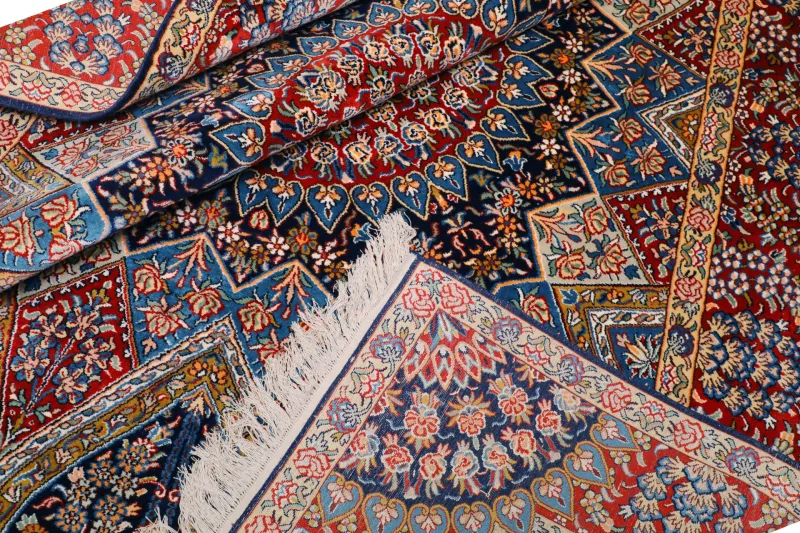
Once yarn is prepared, it passes to the rafugar (weaver) who works on a handloom — typically a pit loom or a frame loom — to construct the base fabric. A plain-weave pashmina shawl of standard dimensions (approximately 28 by 80 inches) requires between three and five days of uninterrupted weaving. Shawls incorporating the intricate kani weave, in which colored threads are interlocked using small wooden bobbins called kanis to create tapestry-like patterns, can demand weeks or months. The most elaborate examples — featuring densely patterned borders in the tradition of the historic "moon shawl" — have historically required years of work by multiple artisans working in coordinated shifts.
Embroidered pashmina, decorated using the sozni needle-work technique, adds another dimension of labor. A single fully embroidered shawl — covered edge to edge in the flowing floral motifs characteristic of the Kashmiri aesthetic — may represent twelve to eighteen months of a single artisan's work. These are the pieces that appear at auction houses and in museum collections. They are, without exaggeration, wearable paintings.
Authenticating Your Investment: A Collector's Practical Guide
The American market presents significant challenges to the pashmina collector. Products labeled "pashmina" range from genuine Kashmiri-origin, hand-processed textiles to machine-made acrylic blends that share nothing with the authentic article beyond a marketing term. The following protocols will materially reduce the risk of acquiring a counterfeit.
Request fiber certification. Legitimate Kashmiri pashmina producers and reputable retailers can provide documentation of fiber origin and micron count, often certified through the Wool Research Association of India or similar bodies. The Craft Development Institute in Srinagar issues a GI (Geographical Indication) tag — a holographic label — for qualifying pashmina products. Ask to see it.
Perform the ring test. Authentic pashmina, owing to its extraordinary fineness, can be drawn through a standard finger ring without resistance. This is not a foolproof test — very fine machine-made fabrics can sometimes pass — but a shawl that snags, bunches, or refuses to pass is almost certainly not genuine.
Assess the hand. Run the fabric across the back of your hand, then against your cheek. Genuine pashmina produces a warmth that is immediate and enveloping, combined with a softness that is difficult to describe but unmistakable in experience. Acrylic and polyester blends feel cool, occasionally scratchy, and lack the subtle weight distribution of real fiber.
Examine the weave structure under magnification. Handwoven fabric exhibits slight, natural irregularities in thread spacing — the signature of human labor. Machine-woven fabric is perfectly uniform. A jeweler's loupe or a smartphone macro lens will reveal this distinction clearly.
Burn a thread. A single thread from the fringe, when touched to a flame, will behave differently depending on composition. Genuine animal fiber burns slowly, self-extinguishes, and produces an ash that crumbles and smells faintly of burning hair. Synthetic fibers melt, bead, and produce black smoke with a chemical odor.
Source from verified retailers. Perhaps the most reliable protection is provenance. Purchasing from retailers with established relationships with Kashmiri artisan communities — and who can speak knowledgeably about specific workshops, weavers, and production methods — dramatically reduces the likelihood of encountering a counterfeit.
The Value Proposition for the American Collector
Authentic Kashmiri pashmina occupies a peculiar position in the luxury market: it is simultaneously one of the world's most coveted textiles and one of its most consistently undervalued, given the labor and ecological specificity involved in its production. A hand-spun, hand-woven pashmina shawl representing four to six weeks of skilled artisan labor is routinely available at price points that would not purchase a single hour of comparable skilled craft work in the United States.
For the collector who approaches pashmina not merely as a fashion accessory but as a cultural artifact and a long-term investment in craft heritage, the calculus is straightforward. These are objects that improve with careful use, that carry the imprint of individual human skill, and that connect their owners to an artistic tradition of extraordinary depth and resilience. Acquiring one demands only that you acquire it correctly.