The New Custodians: How American Collectors Are Keeping Kashmir's Endangered Crafts Alive

Photo: Fairyallen, CC0, via Wikimedia Commons
In an era when mass production threatens centuries-old artisan traditions, a growing community of American collectors has emerged as an unlikely but vital force in Kashmir's cultural survival. By choosing handcrafted textiles and decorative objects over machine-made approximations, these discerning buyers are doing something that goes well beyond interior decoration—they are sustaining livelihoods, preserving techniques, and ensuring that the world's most refined textile heritage endures into the next generation.
This is not sentiment. It is economics—and it matters enormously.
The Stakes of Indifference
To understand why American collecting habits carry such consequence, one must first grasp the precariousness of Kashmir's artisan economy. The Valley is home to craft traditions that, in some cases, predate the Mughal Empire—weaving techniques so labor-intensive and specialized that a single master kani weaver may require a decade of apprenticeship before producing work of saleable quality. A fine kani shawl can take three to four years to complete. Sozni embroidery, at its highest level, demands a precision and patience that few practitioners in the world can claim.
Yet the artisans who carry this knowledge earn wages that, without consistent international demand, cannot compete with the income available in other sectors. When orders dry up, young people in weaving families leave the craft. When they leave, the knowledge leaves with them. Techniques that took generations to develop can vanish within a single one.
The Indian government, various NGOs, and cultural preservation organizations have worked to address this attrition—with mixed results. What no subsidy program can fully replicate is the signal sent by genuine market demand: the message that what a craftsperson makes is valued, sought after, and worth the extraordinary investment of time required to make it well.
That signal, increasingly, is coming from the United States.
A Different Kind of Consumer
The American collectors who have found their way to Kashmiri craft represent a distinct sensibility within the broader luxury market. They tend to be individuals who have grown dissatisfied with the homogeneity of mass-market home goods—who find little meaning in owning objects that could be found in any retail chain from Seattle to Miami. What draws them to Kashmir is precisely the opposite of ubiquity: the knowledge that what they are acquiring is irreplaceable, the product of skills that exist in only one place on earth and in only a handful of living hands.
Consider Margaret, a retired architect based in Portland, Oregon, whose home features an evolving collection of Kashmiri kani shawls displayed as wall textiles alongside her Scandinavian furniture. She describes her initial encounter with a genuine kani piece as transformative. "I had seen Indian textiles before, but nothing that prepared me for the density and intricacy of the weave," she explains. "When I learned how long it had taken to make—and what the weaver earned for that time—I felt a responsibility. I went back and bought two more."
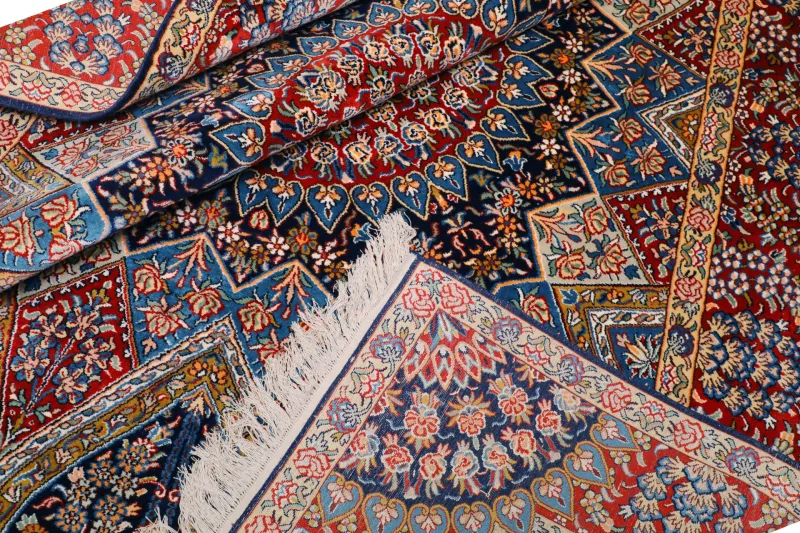
Or consider David and Priya, a couple in suburban Chicago who began collecting Kashmiri hand-knotted carpets after a trip to the region a decade ago. Their collection now includes seven pieces ranging from a small prayer-format rug to a room-sized silk carpet that anchors their living space. "We don't think of them as purchases," David says. "We think of them as relationships—with the people who made them and with the tradition they represent."
These are not isolated examples. Across American cities with strong design cultures—New York, San Francisco, Boston, Washington D.C.—a quiet but growing cohort of collectors has made Kashmiri craft a meaningful part of both their homes and their values.
The Economics of Ethical Collecting
There is a financial dimension to this conversation that deserves honest acknowledgment. Authentic Kashmiri craft is not inexpensive, and it is not meant to be. A genuine pashmina shawl, hand-embroidered by a sozni master, may cost several hundred to several thousand dollars. A hand-knotted silk carpet of significant size can represent an investment comparable to fine art.
For collectors who have done their research, this pricing reflects reality rather than inflation. The cost of raw materials—particularly shahtoosh's ethical successor, genuine pashmina from Changthangi goats—is substantial. The labor investment, measured in months or years rather than hours, is extraordinary. And the supply of truly skilled artisans is, by definition, finite and diminishing.
The alternative—purchasing a machine-made or imported approximation at a fraction of the price—carries its own costs, though they are distributed rather than personal. Those costs are borne by the Kashmiri weaver who loses an order, by the apprentice who cannot be trained because the economics no longer support it, and ultimately by the craft tradition itself, which edges incrementally closer to extinction.
American collectors who choose authenticity are, in this sense, making a choice with consequences that extend far beyond their own walls.
Direct Relationships and the Future of the Craft
One of the most encouraging developments in American collecting culture is the growing preference for direct or near-direct relationships with artisan communities. Rather than purchasing through intermediaries who may or may not maintain transparent supply chains, a number of collectors are seeking out purveyors who can speak specifically to the provenance of individual pieces—naming the workshop, describing the artisan's background, and in some cases facilitating ongoing correspondence.
This kind of relationship changes the nature of the transaction. It transforms a purchase into a patronage—a word with a long and honorable history in the context of craft and art. The great Kashmiri shawl industry of the eighteenth and nineteenth centuries was sustained by exactly this kind of intentional patronage, first from Mughal courts and later from European aristocracy. Today's American collector, consciously or not, occupies a structurally similar role.
House of Kashmir was founded on precisely this premise: that meaningful commerce requires meaningful connection. Every piece we offer carries with it the story of its making—the region, the technique, the tradition. We believe that an informed collector is the craft's best advocate.
What It Means to Collect with Intention
The collectors whose homes feature Kashmiri textiles and decorative objects tend to share a common observation: these pieces do not age in the way that trend-driven decor ages. A hand-knotted carpet laid in a New England farmhouse today will look equally distinguished in thirty years. A sozni-embroidered shawl displayed in a Manhattan apartment does not date itself to any particular season or aesthetic moment. These objects belong to a category that transcends the cyclical nature of design fashion precisely because they were never produced with fashion in mind.
They were produced with permanence in mind—with the understanding that something made with such care deserves to outlast the moment of its creation.
For American collectors willing to engage with that ethos, the rewards are considerable: objects of genuine beauty and cultural depth that enrich a home not merely visually but narratively. And for the artisans of Kashmir's valleys and workshops, each such collector represents something more urgent—a reason to continue, to teach, to refine, and to pass forward a tradition that the world cannot afford to lose.
In choosing authenticity, American collectors are not simply furnishing their homes. They are writing themselves into a story that began centuries ago and, with their participation, has every reason to continue.