A Symbol Written in Thread: The Crescent Moon's Journey Through Kashmiri Art and Craft
Photo: vsvinaykumar, Attribution, via Wikimedia Commons
Few symbols in the decorative vocabulary of Kashmir carry the weight and resonance of the crescent moon. Appearing on shawls, carpets, lacquered boxes, and embroidered wall hangings alike, this singular form has traveled through centuries of cultural exchange, spiritual meaning, and artistic reinvention. For the serious collector, understanding its origins is not merely academic—it is essential to appreciating what you hold in your hands.
Origins at the Crossroads of Empire
The crescent moon entered Kashmiri visual culture through a confluence of influences that is, in itself, a testament to the Valley's extraordinary position in history. Positioned along the ancient Silk Road, Kashmir served as a meeting point for Central Asian, Persian, Mughal, and indigenous Shaivite traditions. The crescent—māh in Persian, chand in Urdu—carried significance across each of these worlds.
In the Persian courtly tradition that deeply influenced Mughal aesthetics, the crescent was associated with royalty, the night sky, and the cyclical passage of time. When Mughal emperors patronized Kashmiri weavers in the sixteenth and seventeenth centuries, they brought with them an artistic vocabulary already saturated with lunar imagery. Simultaneously, Kashmir's indigenous Hindu and Shaivite traditions had long revered the crescent as an adornment of Lord Shiva—depicted resting in his matted hair—lending the symbol a spiritual dimension that predated Islamic influence in the region.
This layering of meanings, rather than creating contradiction, produced something richer: a motif that could speak simultaneously to multiple communities, embodying devotion, elegance, and cosmic order within a single curved line.
How the Motif Moves Across Techniques
What distinguishes the crescent moon's presence in Kashmiri craft is its remarkable adaptability. It does not belong to a single medium or artisan tradition; instead, it migrates fluidly across disciplines, each technique lending it a different character.
On the Kani Loom: In the celebrated woven shawls produced on the kani loom—where wooden spools replace a single shuttle—the crescent often appears as a border accent or as a repeating element within the hashia, the decorative edging. Woven at extraordinary density, sometimes exceeding two thousand wefts per inch, the crescent rendered in kani work possesses an almost architectural precision. The curvature must be achieved entirely through the interlocking of colored threads, making each iteration a small geometric triumph.
In Sozni Embroidery: The needle-worked tradition known as sozni produces crescents of an entirely different character—fluid, expressive, and deeply personal to the hand of the craftsperson. Here, the motif frequently appears in conjunction with floral sprays and the famed buta (the teardrop form often misidentified in the West as the paisley). A master sozni artisan may spend several months completing a single shawl, and the crescent within that composition functions almost as a punctuation mark—a moment of stillness amid botanical abundance.
In Paper Mâché: Kashmir's kar khamdodi tradition—the art of paper mâché—offers perhaps the most vivid expression of the crescent. Lacquered boxes, trays, and decorative panels frequently feature crescents rendered in gold and lapis-toned pigments against deep crimson or black grounds. The three-dimensional quality of the lacquered surface gives the motif a jewel-like luminosity that translates beautifully into contemporary American interiors, particularly when displayed against neutral walls where the color contrast can be fully appreciated.
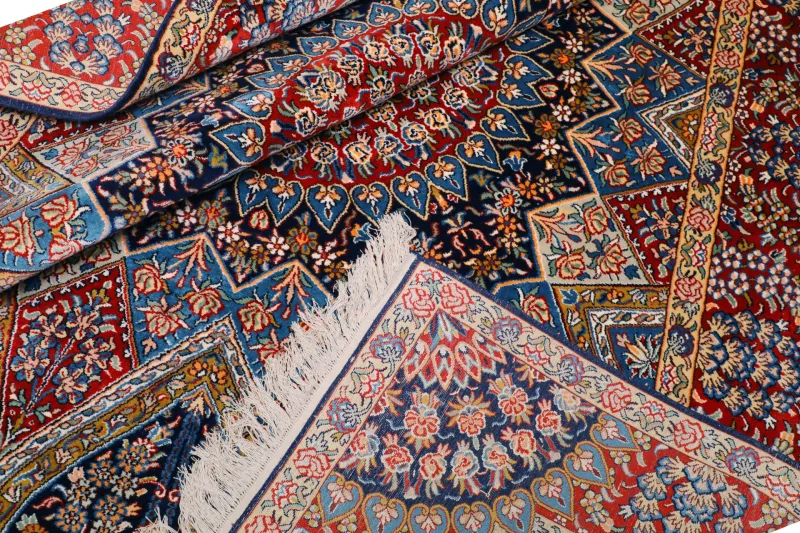
In Hand-Knotted Carpets: On the floor, the crescent appears most often in medallion compositions and border systems of Kashmiri pile carpets. Given the scale of carpet production, the motif here can achieve a grandeur unavailable to smaller formats. A room-sized carpet featuring repeated crescent medallions in hand-spun wool or silk creates a visual rhythm that is simultaneously ancient and surprisingly modern.
Spiritual Resonance and Cultural Narrative
To collect a piece bearing the crescent moon is to acquire something that carries genuine narrative weight. For Muslim Kashmiri artisans, the symbol connects to a broader Islamic artistic tradition that has, for centuries, elevated geometric and celestial forms as expressions of the divine order. For Hindu craftspeople, it retains its association with Shaivite cosmology. And for the Sufi poetic tradition—which exerted profound influence on Kashmiri cultural life—the crescent and the moon at large served as recurring metaphors for the soul's longing and its journey toward completeness.
This convergence is not incidental. It reflects the Kashmiriyat—the ethos of pluralism and shared cultural identity—that has historically defined the Valley's artistic output. When you encounter the crescent on an antique shawl or a contemporary embroidered cushion cover, you are, in a sense, holding evidence of that long coexistence.
Authenticating the Motif: What Collectors Should Know
As demand for Kashmiri decorative arts has grown among American collectors, so too has the market for imitative goods produced outside the Valley—or manufactured using industrial methods that replicate the appearance of hand-craftsmanship without its substance. The crescent motif, given its recognizability, is frequently reproduced in printed textiles and machine-made carpets marketed as Kashmiri.
Several indicators can help distinguish authentic hand-worked pieces:
- Irregularity as a virtue: In genuine sozni embroidery or kani weaving, the crescent will exhibit micro-variations in curvature and stitch density. These are not flaws; they are the signature of a human hand. Machine reproduction tends toward an unsettling uniformity.
- Reverse-side evidence: Turn any embroidered or woven textile over. Authentic hand-embroidery will show the logic of the needle's path on the reverse—consistent, purposeful, and often nearly as refined as the front. Machine embroidery reveals a chaotic underside of thread jumps and locked stitches.
- Provenance and documentation: Reputable purveyors of Kashmiri craft, including those who work directly with Valley artisans, can typically provide information about the workshop or individual craftsperson responsible for a given piece. This chain of custody is increasingly important both ethically and as a marker of value.
- Material quality: The crescent rendered in genuine pashmina or hand-spun silk will catch light differently than synthetic alternatives—with a warmth and depth that photography rarely captures adequately. Handling remains the most reliable test.
The Crescent in the Contemporary American Home
For collectors integrating Kashmiri pieces into American living spaces, the crescent motif offers a particularly versatile entry point. Its abstract elegance reads as sophisticated rather than overtly ethnic, allowing it to coexist with mid-century modern furniture, Scandinavian minimalism, or more eclectic interiors with equal grace.
A lacquered paper mâché bowl bearing a gilded crescent on a dining credenza; an embroidered silk cushion in jewel tones on a linen sofa; a framed textile fragment mounted as wall art in a study—each placement transforms the object from mere decoration into a conversation about history, craft, and the enduring human impulse to mark the sky's beauty in whatever material lies at hand.
The crescent moon, after all, has been rising over Kashmir for millennia. In acquiring a piece that carries it, an American collector becomes part of that long continuity—a custodian of a symbol still being written, thread by thread, in the workshops of Srinagar.