Knowing What You Own: A Collector's Field Guide to Verifying Genuine Kashmiri Textiles

Photo by Photo by Guido Coppa on Unsplash on Unsplash
The American market for Kashmiri textiles has never been more vibrant — nor more complicated. Alongside the genuine masterworks produced by generations of Valley artisans, a significant volume of machine-made and factory-finished goods now travels under the same regional labels, often at price points designed to suggest authenticity without delivering it. For collectors who regard these textiles as both cultural artifacts and long-term investments, the ability to distinguish the real from the approximate is not merely useful. It is essential.
What follows is a practical framework for evaluating Kashmiri textiles — drawn from conversations with master weavers, embroiderers, and the provenance specialists who document their work — organized around the three pillars every serious collector should examine: material composition, technical execution, and documentation.
The First Question: What Is It Actually Made Of?
Authentic Kashmiri luxury textiles begin with exceptional raw materials, and the most celebrated of these is Changthangi pashmina — the undercoat fiber of the Changpa nomads' goats, harvested at altitudes above 14,000 feet in the Ladakh region. Genuine pashmina fiber measures between 12 and 16 microns in diameter, a fineness that places it well below the threshold of cashmere commercially sold in the United States, which is permitted by the Federal Trade Commission to measure up to 19 microns.
When you handle a piece, the tactile experience is telling but not conclusive. Authentic pashmina will feel extraordinarily light against the palm — almost weightless — while exhibiting a subtle warmth that synthetic blends cannot replicate. A simple burn test, though imperfect, remains useful: genuine animal fiber burns slowly, produces a char that crumbles to ash, and emits a faint smell of singed hair. Synthetic fibers melt, bead, and produce a sharper chemical odor.
For those seeking laboratory certainty, fiber analysis services are available through textile conservation labs and some university programs. A micron count below 16, combined with a confirmed animal-fiber composition, is a strong indicator that the raw material is what it claims to be.
Reading the Weave: What Handwork Actually Looks Like
Material quality is only the beginning. The techniques employed in constructing a Kashmiri textile are equally diagnostic, and they leave behind a visual and physical record that machine production cannot authentically replicate.
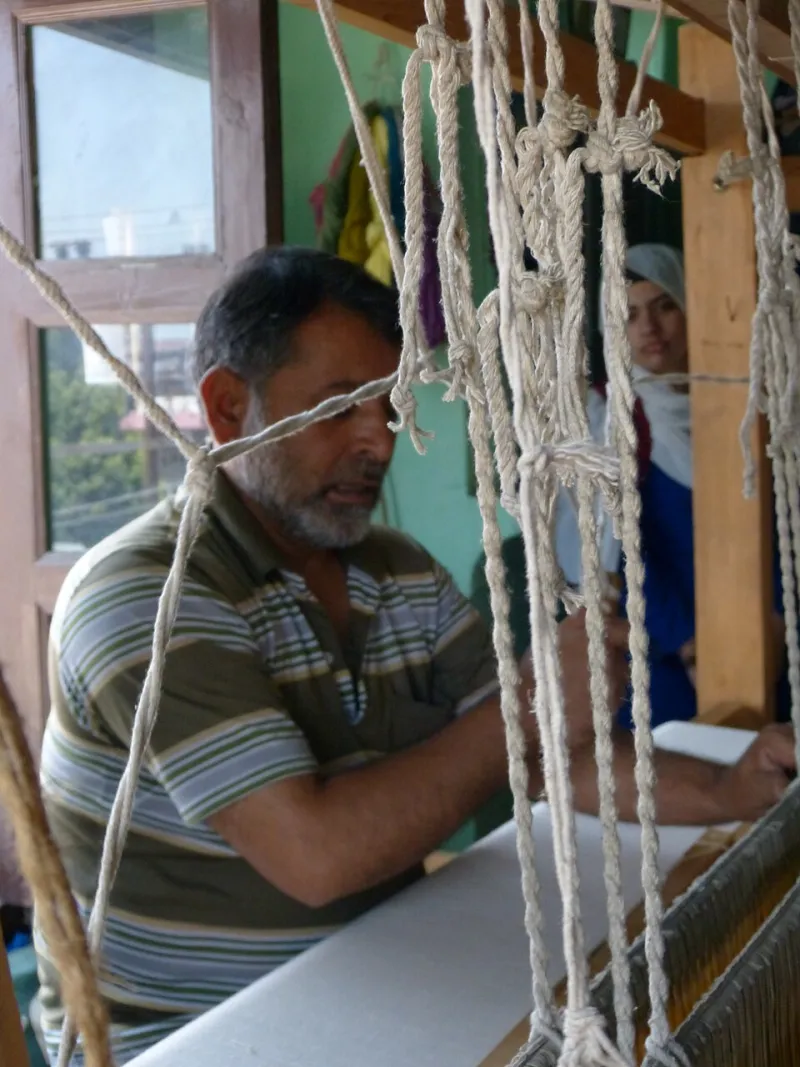
Kani weaving, the interlocked tapestry technique used to produce the finest Kashmiri shawls, is perhaps the most demanding of all regional crafts. Each motif is built by a weaver manipulating dozens of small wooden bobbins — called kanis — individually across the warp threads. The resulting fabric has no floating threads on its reverse; instead, the back of a genuine kani shawl displays a complex, almost mirror-image pattern of interlocked color blocks. Machine-made Jacquard imitations, by contrast, typically show long floating threads at the reverse, or a printed rather than woven surface.
"Turn it over," advises one master weaver from the Kanihama cluster whose family has practiced kani weaving for four generations. "If the back looks almost as deliberate as the front, you are looking at real work. If the back is messy or uniform in a mechanical way, something is wrong."
Sozni embroidery, the fine needle-and-thread work applied to finished fabric, carries its own set of markers. Authentic sozni is worked from the reverse side of the fabric, meaning the embroiderer stitches blind, guided only by the transferred design outline. This produces a characteristic slight variation in stitch tension across the surface — a quality that reads as subtle life rather than imperfection. Under magnification, individual stitches will show the minor inconsistencies inherent to human execution. Digitally embroidered imitations, even high-quality ones, display a regularity of stitch spacing and depth that becomes obvious once you know what to look for.
Spend time examining the density of work relative to the price. A genuine sozni shawl representing two to three years of a master embroiderer's labor will be priced accordingly. Pieces offered at a fraction of that cost almost certainly represent either machine embroidery, a lower-skill regional workshop, or outright misrepresentation.
The Role of Provenance Documentation
Beyond the object itself, documentation is the collector's most reliable ally — and the area most frequently neglected in casual acquisitions.
The Craft Development Institute (CDI) in Srinagar, along with the Handicrafts and Handloom Corporation of Jammu & Kashmir, issues certification for authenticated Kashmiri handcrafts. The GI (Geographical Indication) tag, granted to Kashmiri pashmina under Indian intellectual property law, is a formal legal designation confirming regional origin and handcraft production. Reputable dealers should be able to provide either the original certification or a clear chain of provenance tracing the piece to a documented workshop or named artisan.
When purchasing through established retailers — whether in person or online — ask directly: Can you provide the artisan's name or workshop? Is there a GI tag or CDI certification associated with this piece? What is the documented acquisition history? A trustworthy source will answer these questions readily. Hesitation or vague responses about "Kashmiri-style" production or "inspired by" regional traditions are significant warning signs.
Common Imitations and How to Recognize Them
The most prevalent substitutes in the American market fall into a few recognizable categories.
Amritsar shawls — produced in Punjab using power looms — are frequently sold alongside or in place of genuine Valley-produced kani work. The weave structure is similar enough to mislead casual buyers, but the reverse of an Amritsar shawl will typically show the floating-thread signature of mechanical production.
Printed pashmina is perhaps the most widespread misrepresentation at lower price points. These pieces use a genuine or blended pashmina base fabric but apply design through screen or digital printing rather than weaving or embroidery. The design sits on the surface of the fabric rather than within its structure, and close examination of the edge of any motif will reveal the slight bleeding or pixelation characteristic of print application.
Acrylic and viscose blends marketed as pashmina remain common in tourist markets and some online retail environments. The burn test described earlier is particularly useful here, as is the weight-to-warmth ratio: synthetic blends tend to feel heavier for their apparent warmth than genuine fiber.
Building a Collection With Confidence
The experienced collector approaches each acquisition as an act of stewardship — not merely purchasing an object, but preserving and honoring the knowledge embedded within it. That posture naturally demands rigor.
Develop relationships with dealers who can speak fluently about technique, origin, and documentation. Visit regional exhibitions and museum collections where authenticated pieces are on display, and use those encounters to calibrate your tactile and visual judgment. When possible, commission directly from named artisans through verified channels — a practice that not only guarantees provenance but directly sustains the craftspeople whose skills make these objects possible.
At House of Kashmir, every piece we carry is sourced with full documentation of origin and artisan, because we believe that a textile without a verifiable story is simply fabric. The objects that endure — the ones passed down through families, donated to institutions, and studied by future generations — are those whose authenticity was never in question.
Knowing what you own is not a technicality. It is the beginning of a relationship with one of the world's most extraordinary living craft traditions.