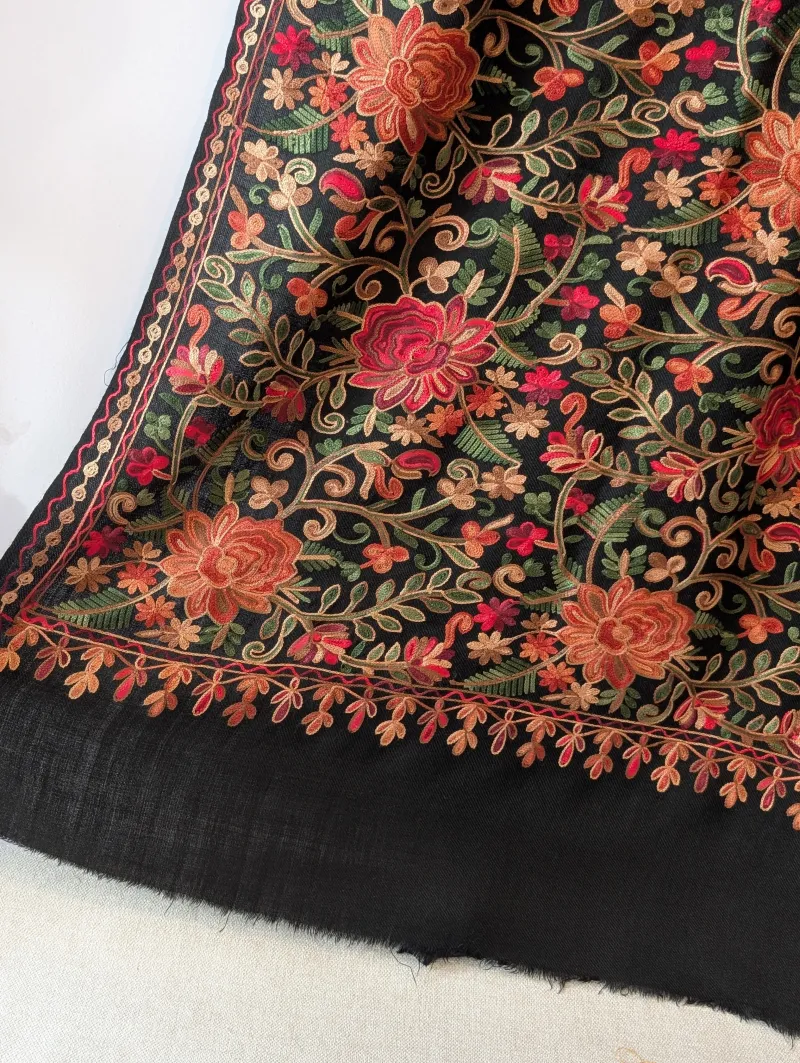
The Principled Pause: Why Kashmir's Master Craftspeople Are Choosing Depth Over Scale
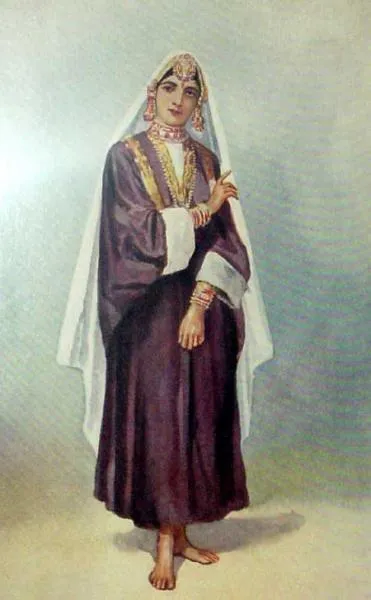
Photo: M. V. Dhurandhar, Public domain, via Wikimedia Commons
In an era defined by acceleration — faster shipping, faster fashion, faster everything — a different kind of momentum is shaping the workshops of the Kashmir Valley. It moves at the pace of a single needle passing through wool, of a weaver's hand counting threads in lamplight, of a craftsman who measures success not in units produced but in the depth of attention poured into each one. Kashmir's master artisans are, with increasing deliberateness, choosing to make less.
This is not scarcity manufactured for marketing purposes. It is something more principled, more personal, and — for those who collect with genuine intention — far more significant.
The Economics of Refusal
On the surface, the decision to resist industrialization appears economically irrational. Mechanized looms can replicate certain weave structures in hours that a hand-weaver requires weeks to complete. Digital printing technologies can approximate the visual effect of a hand-embroidered shawl at a fraction of the cost. The market for affordable Kashmiri-inspired goods is enormous, and the infrastructure to serve it exists.
Yet a growing cohort of Kashmir's most accomplished craftspeople — those whose families have practiced kani weaving, sozni embroidery, or papier-mâché lacquerwork across multiple generations — are not merely uninterested in that market. They are philosophically opposed to it.
Their reasoning is rooted in a concept that does not translate neatly into Western business language: the idea that a craft object carries within it the consciousness of its maker. To rush that process, they argue, is not simply to produce an inferior product. It is to produce an object that is, in a fundamental sense, empty.
"When I sit at my loom, I am not manufacturing," one master kani weaver from Kanihama has explained to visiting textile scholars. "I am thinking. Every color change, every interlocked thread — these are decisions. If I make a thousand shawls, I am no longer making decisions. I am repeating. And repetition is the death of craft."
A Counterculture Rooted in Ancient Practice
What appears radical in a modern commercial context is, in fact, a return to historical norms. For centuries, Kashmiri textiles were produced in intimate workshops — karkhanas — where a single complex shawl might occupy a master weaver and his apprentices for the better part of a year. The legendary kani shawls of the Mughal period, prized by European nobility and Indian courts alike, were never mass-market commodities. Their value was inseparable from their scarcity, and their scarcity was inseparable from the time they demanded.
The industrialization of Kashmiri textile production, which accelerated through the twentieth century, represented a rupture with that tradition — one that many craftspeople now view as a period of cultural erosion rather than progress. The revival of intentionally small-scale, long-timeline production is, in this reading, less a contemporary trend than a restoration.
This framing resonates strongly with American collectors who have grown sophisticated in their understanding of provenance and process. In a market saturated with goods that claim Kashmiri heritage while bearing only the most superficial relationship to traditional technique, the commitment to genuine craft has become a meaningful differentiator — and a powerful story.
What Smaller Runs Actually Mean for the Collector
For those accustomed to the rhythms of American retail — where a desired item can typically be sourced, ordered, and delivered within days — acquiring a piece from one of Kashmir's intentional small-producers requires a recalibration of expectations. Waitlists of six months to two years are not uncommon for bespoke commissions from recognized masters. Certain designs are produced in editions of fewer than a dozen pieces annually.
This timeline is not an inconvenience to be engineered away. It is, collectors increasingly understand, the point.
The waiting period itself becomes part of the object's meaning — a sustained anticipation that transforms acquisition into something closer to patronage. Collectors who commission directly from small workshops often describe an ongoing correspondence with their artisan: updates on progress, photographs of work in development, occasional adjustments to color or dimension. By the time the finished piece arrives, the collector has participated, however distantly, in its creation.
This relational quality is something that no logistics optimization can replicate.
The Integrity Question
There is, of course, an economic dimension to this philosophical stance that deserves honest acknowledgment. Artisans who produce less must charge more — and the American luxury market, whatever its appetite for narrative, remains sensitive to price. The decision to limit production is sustainable only when the collector community genuinely values what that limitation represents.
The encouraging reality is that this community is growing. Across American cities with established collector cultures — New York, San Francisco, Chicago, and increasingly in smaller markets with concentrations of design-conscious consumers — there is a discernible shift away from the accumulation of many things toward the deliberate acquisition of fewer, better ones. The principles of slow food and slow travel have found a natural extension in what might be called slow collecting.
Kashmiri artisans who have chosen the principled pause are, perhaps unknowingly, perfectly positioned for this moment. Their refusal to scale is not merely an artistic posture. It is a value proposition of considerable power: the assurance that what you hold was made by a specific person, with full attention, over a meaningful span of time, and that no identical object exists anywhere else in the world.
Preserving the Capacity for Excellence
Beyond individual economics, there is a broader argument for the importance of small-scale, high-integrity production — one that concerns the long-term survival of Kashmir's most complex craft traditions.
Many of the techniques at stake are extraordinarily difficult to learn and nearly impossible to transmit at industrial scale. The kani weaving process, in which patterns are executed entirely from memory using coded talim notation, requires years of apprenticeship before a weaver can work independently on complex designs. Sozni embroidery, at its finest, involves stitch counts per square inch that approach the limits of human visual acuity.
These skills are preserved not in manuals or machines but in the bodies and minds of practicing craftspeople. When production volume demands that technique be simplified, it is precisely these most demanding — and most irreplaceable — capabilities that are first to disappear.
The artisans who are choosing depth over scale are, in this sense, doing more than protecting their own artistic integrity. They are maintaining the conditions under which genuine mastery remains possible, and ensuring that the next generation of Kashmiri craftspeople inherits a tradition worth inheriting.
For the American collector who chooses to support that commitment with their patronage, the purchase of a single, slowly made, uncompromised piece carries a weight that no mass-produced approximation can approach. It is, ultimately, not a transaction. It is an act of cultural stewardship — and one of the more meaningful ways that individual taste can intersect with something larger than itself.