The Meditative Loom: Ancient Presence Practices Woven Into Every Kashmiri Thread
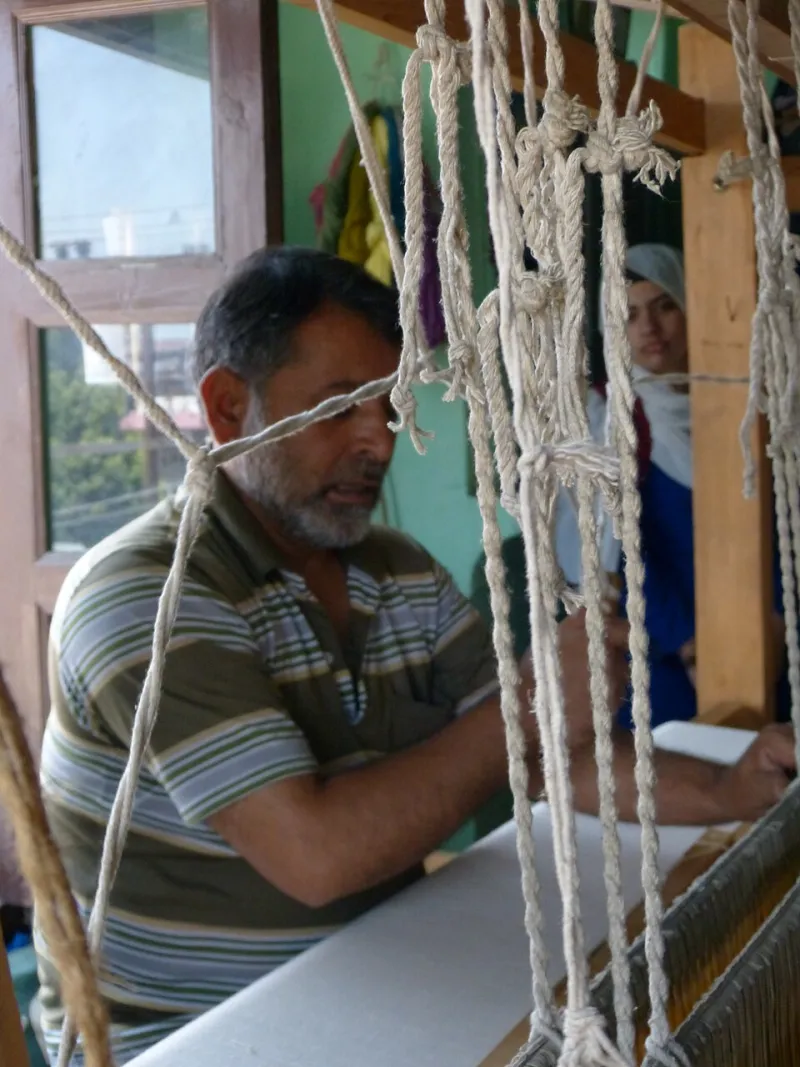
Photo: Zatara-Iqbal, CC BY-SA 4.0, via Wikimedia Commons
In the foothills of the Himalayas, where the air carries the faint perfume of saffron and pine, a weaver settles before his loom before dawn. He does not reach for his phone. He does not queue a playlist or recite a guided affirmation. He breathes, orients his hands, and enters a state that Western wellness culture has spent the better part of two decades attempting to manufacture—and has, by most honest accounts, only partially succeeded.
Mindfulness, as it is sold to American consumers today, arrives in the form of subscription apps, breathwork retreats, and neatly packaged supplements. It is, at its most commercially distilled, a product. What the master craftspeople of Kashmir practice is something categorically different: a form of sustained, embodied attention that has been refined across generations and is inseparable from the objects they create. To understand this distinction is to understand why a hand-embroidered Kashmiri shawl or a fine kani weave feels, to many who own one, like something more than fabric.
Attention as the Raw Material
Shabir Ahmad, a third-generation sozni embroiderer working in the Srinagar Valley, describes the mental state required for his craft in terms that would be familiar to contemplative traditions worldwide, though he arrived at them entirely through practice.
"Before I place the needle, I must already know where it will come out," he explains. "My mind cannot be in two places. If it is, the stitch knows."
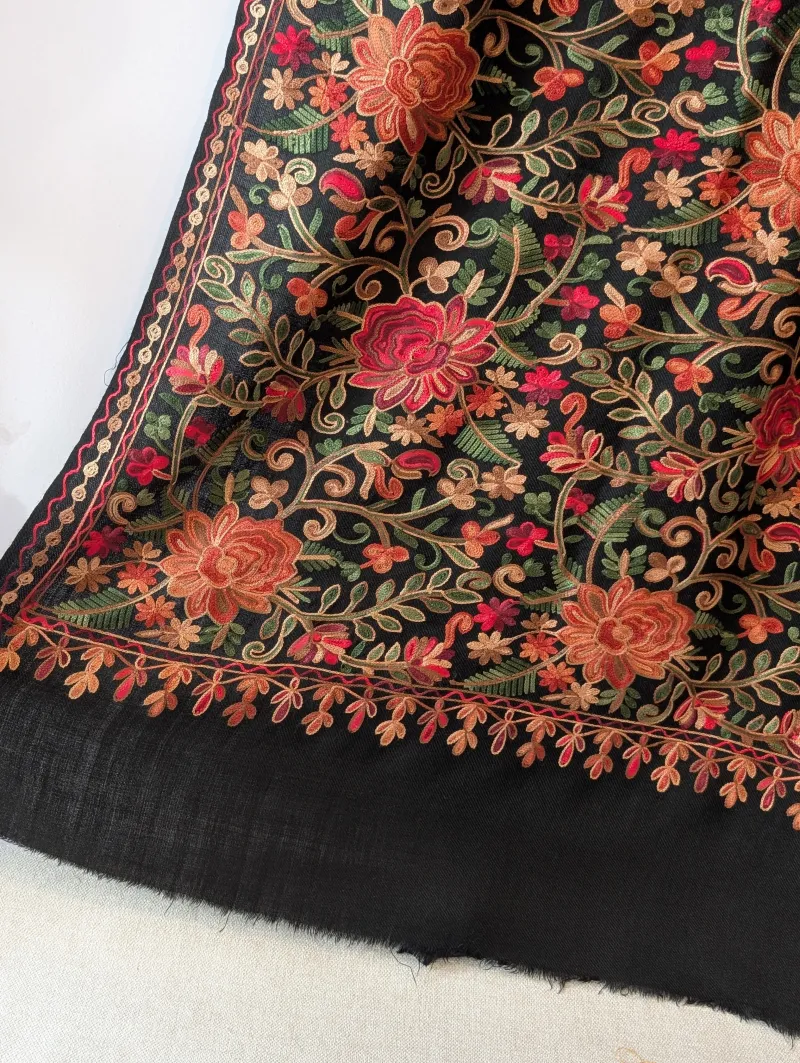
This is not metaphor. The sozni technique—a needle embroidery of extraordinary fineness worked on pashmina—demands that the craftsperson visualize each stitch's trajectory before executing it. A single error in judgment, compounded across hundreds of thousands of stitches, can compromise the symmetry of a design that may take eighteen months to complete. The consequence of distraction is not inconvenience; it is the potential ruin of an entire piece.
What Ahmad describes is functionally identical to what neuroscientists call "flow state"—a condition of deep, effortless concentration in which self-consciousness recedes and performance becomes fluid. The difference is that Ahmad does not pursue this state as a goal. It is simply what the work requires.
The Discipline Western Wellness Skips
Contemporary mindfulness culture, particularly as it has proliferated across American urban centers, tends to emphasize comfort. Meditation cushions are ergonomically designed. Apps offer "gentle" sessions calibrated to busy schedules. The implicit promise is that presence can be achieved without significant friction.
Kashmiri craft traditions suggest otherwise. The kani weave—produced on a pit loom using small wooden spools called kanis to interlace colored wefts according to a complex pattern code called a talim—requires a weaver to hold multiple sequences of information in working memory simultaneously, for hours at a stretch, day after day. There is no shortcut, no modification for beginners. The loom is indifferent to a weaver's mood or energy level.
Naseem Bano, one of the few women practicing the kani technique in her village outside Kanihama, puts it plainly: "The loom does not care if you are tired. You must come to it completely, or you do not come at all."
This rigorous quality—what might be called disciplined surrender—is largely absent from Western wellness frameworks, which tend to accommodate the practitioner rather than ask the practitioner to rise. The result is a form of mindfulness that remains, for many Americans, pleasant but shallow.
What Collectors Are Discovering
Among the community of American collectors who have begun acquiring authentic Kashmiri textiles—through discerning retailers, estate sales, and direct relationships with artisan cooperatives—a recurring observation has emerged. The pieces seem to resist the ambient noise of contemporary life in a way that mass-produced goods, however beautiful, do not.
A New York-based interior designer who collects kani shawls describes the experience of handling them as "almost corrective." "When I pick one up, I slow down," she says. "I don't know how else to explain it. It's as though the object itself has a pace, and it insists you match it."
This perception is not sentimental. It may, in fact, be a form of material intelligence. Objects made under conditions of sustained, disciplined attention carry the record of that attention in their physical structure. The evenness of the weave, the precision of the color gradations, the coherence of the pattern across the full length of a shawl—these are not merely aesthetic qualities. They are evidence of a particular quality of mind, preserved in fiber.
Owning such a piece, and learning to perceive it with corresponding attentiveness, becomes its own contemplative practice.
Presence as Inheritance
What distinguishes Kashmiri craft traditions from wellness trends is, ultimately, their relationship to time. Mindfulness as a commercial product promises results within weeks. The mental discipline of a Kashmiri master craftsperson develops across decades and is transmitted across generations—not through manuals or curricula, but through the long, patient apprenticeship of sitting beside someone who has already learned to be still.
Ghulam Nabi Wani, who has been weaving for over forty years and whose son has recently joined him at the loom, speaks of this transmission with characteristic economy. "I don't teach him to be calm," he says. "The work teaches him. I only show him the work."
This is the aspect of Kashmiri craft wisdom that Western wellness culture, for all its sophistication, has not yet found a way to package: the understanding that genuine presence is not a technique applied to life, but a capacity cultivated through sustained engagement with something that demands your best self.
Bringing the Practice Home
For American collectors, the invitation is not to romanticize a distant culture or to appropriate a spiritual tradition. It is simpler, and more personal, than that. It is to receive a handmade Kashmiri textile as the object it actually is—a record of thousands of hours of human attention, offered across an enormous distance of geography and culture.
To handle such a piece with corresponding care, to learn its patterns and understand something of the technique that produced them, to place it in a home with the deliberateness it deserves—these are not grand gestures. They are small, repeated acts of attention. Which is, as every Kashmiri weaver knows, exactly where presence begins.