Measured in Months, Not Minutes: How Kashmiri Embroidery Defines the True Meaning of Sustainable Luxury
Photo: Unknown scribe and artist, Public domain, via Wikimedia Commons
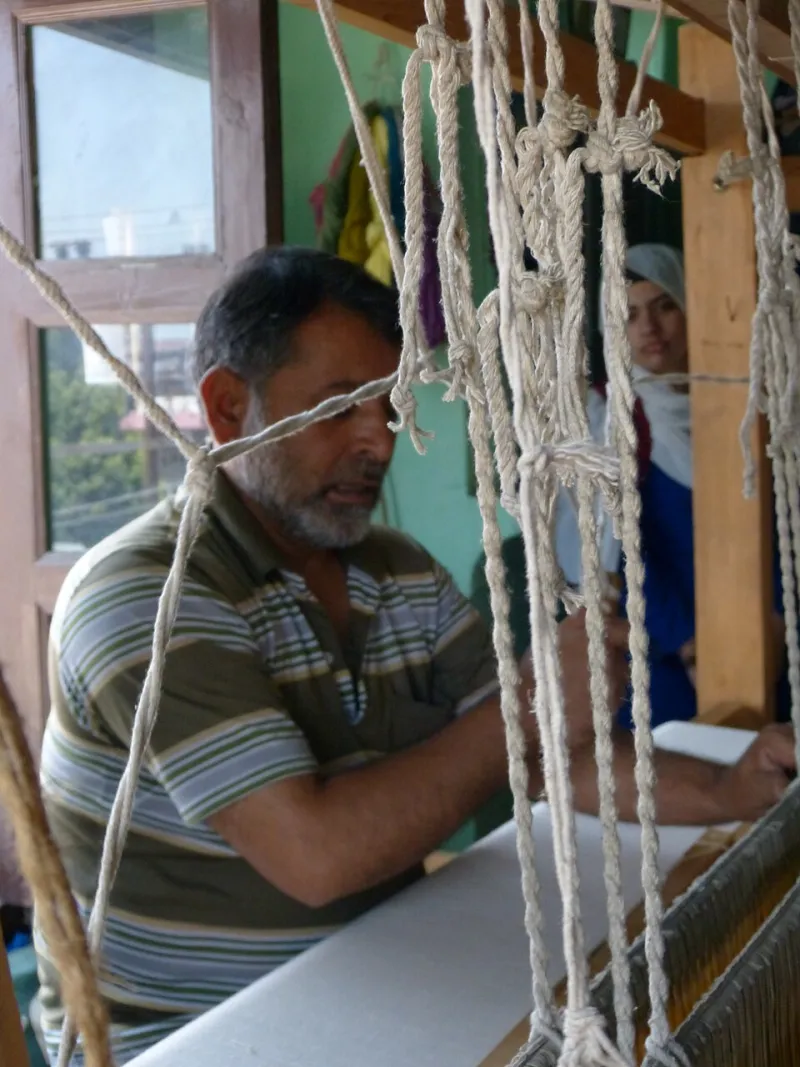
Somewhere in the old quarters of Srinagar, in a room where natural light filters through a latticed window, an artisan draws a needle through wool with the same unhurried deliberateness that his grandfather once did. He is perhaps three months into a shawl that will require six more. There is no assembly line, no production quota affixed to the wall, no algorithm optimizing his output. There is only the pattern, the thread, and the practiced silence between each stitch.
This is sozni embroidery — one of Kashmir's most refined needle arts — and it operates according to a logic entirely foreign to the modern fashion industry. Understanding that logic is, increasingly, one of the most important things an American luxury consumer can do.
The Arithmetic of Fast Fashion's Damage
The statistics surrounding the global fashion industry's environmental footprint are by now familiar, if no less alarming for their repetition. The sector accounts for an estimated ten percent of annual global carbon emissions. It is the second-largest consumer of the world's water supply. The rise of ultra-fast fashion platforms has compressed trend cycles to a matter of weeks, producing garments designed — whether explicitly or implicitly — to be discarded.
The American consumer, in particular, purchases roughly five times more clothing today than in 1980, yet keeps each garment for half as long. The result is a system built on throughput: produce cheaply, sell quickly, discard without ceremony. Sustainability initiatives within this system — recycled polyester blends, carbon-offset shipping, secondhand resale programs — are genuine efforts, but they are also, in a meaningful sense, repairs to a structure whose foundations remain compromised.
Kashmiri embroidery does not operate within this structure. It predates it by centuries.
The Ecology of the Slow Stitch
Traditional Kashmiri embroidery techniques — among them sozni, tilla (metallic thread work), and aari (chain-stitch hook work) — share a foundational characteristic: they are irreconcilably slow. A master embroiderer working on a fine sozni shawl may complete fewer than one square inch of detailed pattern per day. A full piece, depending on its complexity, can absorb the focused labor of a single artisan for anywhere from several months to several years.
This slowness is not inefficiency. It is, rather, the mechanism through which durability, intention, and ecological restraint are built directly into the object.
Consider the material inputs. Authentic Kashmiri embroidery is typically executed on pashmina or fine wool grounds using threads derived from natural fibers. The dyes used by traditional artisans are frequently plant-based — drawn from walnut husks, indigo, saffron, and other botanical sources native to the Himalayan region. These materials biodegrade. They do not persist in landfills for decades. They do not shed microplastics into waterways with each wash cycle.
Consider, too, the carbon arithmetic of a piece made entirely by hand. No industrial machinery hums through the night in a Kashmiri embroiderer's workshop. The energy consumed in producing a hand-embroidered shawl is, by any reasonable measure, a fraction of that required to manufacture, ship, and retail its fast-fashion equivalent.
What Longevity Actually Looks Like
The sustainability conversation in luxury fashion has grown considerably more sophisticated in recent years, yet it still tends to privilege material composition over temporal durability. A garment made from organic cotton but constructed to last two seasons is, in the long arc of environmental accounting, a less responsible choice than one made from conventional materials but designed to endure for decades.
Kashmiri embroidered textiles, when properly cared for, are generational objects. The investment of craft that goes into their creation — the months of skilled labor, the careful selection of materials, the transmission of pattern knowledge accumulated across generations — produces pieces whose physical integrity is matched by their cultural permanence.
American collectors who have integrated Kashmiri embroidered shawls and textiles into their wardrobes frequently report wearing the same pieces across fifteen, twenty, or more years without meaningful deterioration. This is not coincidental. It is the direct consequence of a production philosophy that treats longevity as a non-negotiable design parameter rather than a marketing claim.
A shawl worn for twenty years and then passed to a daughter or son is, in the most literal sense, a zero-waste object. Its cost-per-wear calculation, were one to perform it, would be virtually negligible. Its environmental cost, amortized across decades of use, approaches the irreducible minimum.
The Human Dimension of Ethical Luxury
Sustainability, properly understood, encompasses the welfare of the people who make things as well as the ecological conditions under which those things are made. Here, too, the Kashmiri embroidery tradition offers a model that fast fashion has consistently failed to provide.
The artisans who practice sozni and aari embroidery are skilled specialists whose training typically spans many years of apprenticeship. Their work commands — or should command — a price commensurate with its complexity and duration. When collectors in the United States purchase an authentically hand-embroidered Kashmiri piece at a price that reflects its true labor content, they are participating in an economic relationship that sustains a living craft tradition and the families who depend upon it.
This stands in marked contrast to the supply chains that underpin disposable fashion, where the compression of retail prices is achieved, almost invariably, through the compression of wages and working conditions at the point of production.
The silence between the stitches, in this sense, is not empty. It contains the accumulated expertise of a craftsperson who has earned the right to work slowly, to work well, and to be compensated accordingly.
Collecting with Conscience
For the American collector approaching Kashmiri embroidery for the first time, a few orienting principles are worth keeping in mind.
Authenticity is the first and most essential consideration. The market for Kashmiri textiles includes a significant volume of machine-embroidered or printed goods represented, sometimes misleadingly, as handcrafted. Genuine sozni work is identifiable by the fineness and irregularity of its stitching, the complexity of its shading, and — frankly — by a price point that reflects months of human labor. Pieces that seem implausibly affordable almost certainly are.
Provenance matters as well. Purchasing through established retailers with transparent supply chains and direct relationships with Kashmiri artisan communities provides the clearest assurance that the piece you acquire genuinely supports the tradition it represents.
Finally, consider the object's intended life. A hand-embroidered Kashmiri shawl is not a seasonal accessory. It is, or ought to be, a permanent acquisition — something to be worn with intention, stored with care, and eventually passed forward. Approaching it in those terms is not merely good stewardship of a beautiful object. It is the fullest possible expression of what sustainable luxury actually means.
The artisan in Srinagar draws his needle through the wool once more. Outside, the city moves at its ordinary pace. Inside, time observes different rules — and in that difference lies one of the most coherent answers the luxury world has yet produced to the question of how we might consume with greater wisdom.