The Economics of Enough: How Kashmir's Artisans Built a Luxury Market on the Power of Refusal
There is a question that any serious business consultant would ask upon visiting a Kashmiri embroidery atelier: Why don't you simply hire more hands? The waiting lists are long. The demand, particularly from collectors in the United States and Western Europe, has never been more robust. The raw materials are available. The answer, offered with characteristic composure by the craftspeople themselves, is not what most Western business minds expect to hear.
"What we make cannot be made faster," explains a senior artisan affiliated with a multigenerational embroidery collective in the Kashmir Valley. "The moment we try, it becomes something else entirely. And that something else is not what anyone is paying for."
This is not nostalgia speaking. It is, as a growing body of luxury economists and market analysts are beginning to acknowledge, one of the most sophisticated business philosophies operating in the global craft sector today.
A Different Definition of Growth
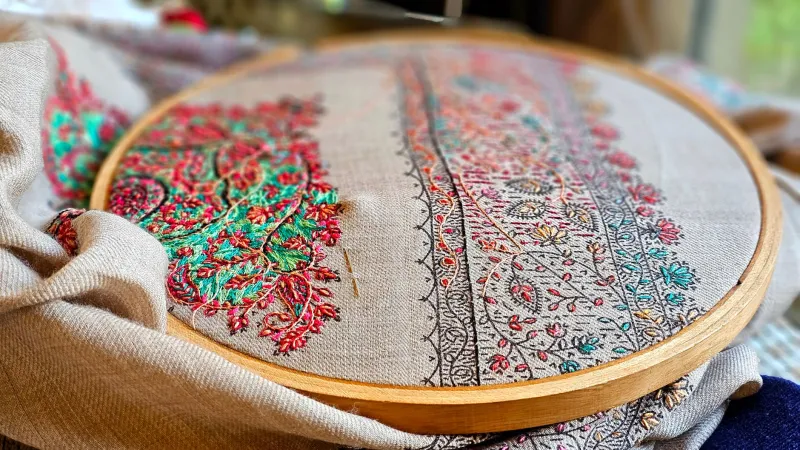
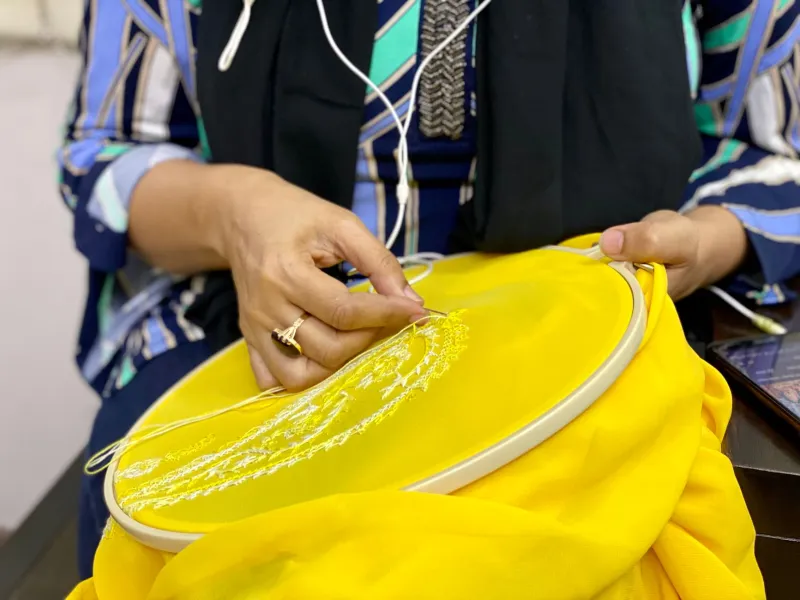
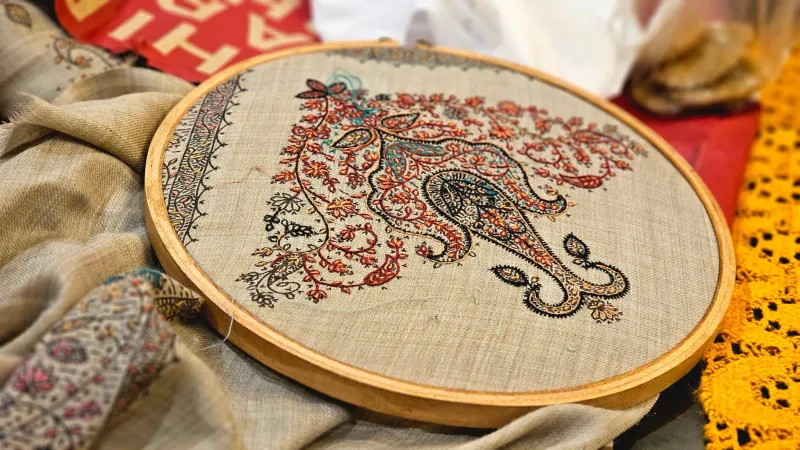
To understand why limitation functions as a competitive advantage in Kashmiri craft, one must first understand what is actually being sold. A hand-embroidered pashmina shawl produced through the traditional tilla dozi or sozni technique is not merely a textile. It is the accumulated result of years of apprenticeship, a vocabulary of motifs passed through generations, and anywhere from six months to three years of a single artisan's concentrated attention. The object carries within it what economists sometimes call embedded labor — but in Kashmir's finest workshops, the embedded element is not simply time. It is mastery, and mastery, by definition, does not scale.
When luxury market analysts at firms tracking the ultra-high-net-worth consumer segment speak of "scarcity signaling," they typically mean controlled inventory — the deliberate withholding of product to maintain price points. What Kashmir's artisan collectives practice is something categorically different. Their scarcity is not manufactured; it is structural. A master embroiderer who has spent forty years developing the particular tension of their needle cannot be replicated by a factory floor, and no amount of capital investment changes that arithmetic.
This distinction matters enormously to the discerning American collector. In a market flooded with goods that perform scarcity while concealing mass production, authentic constraint has become the rarest signal of all.
The Collective Model and Its Quiet Power
Across the Kashmir Valley, many of the region's most respected craft traditions are organized not through individual studios but through cooperatives and family collectives that have resisted vertical integration for generations. These structures, while unfamiliar to American consumers accustomed to brand hierarchies and corporate supply chains, function with a strategic coherence that rewards careful examination.
Within these collectives, knowledge is distributed rather than concentrated. Senior artisans mentor apprentices over periods that routinely span a decade or more. Quality control is communal — a finished piece passes through multiple experienced sets of eyes before it is considered complete. The result is not merely consistency; it is a form of collective accountability that no quality assurance department can replicate.
Perhaps more significantly, these structures insulate craftspeople from the pressure to compromise. When a foreign buyer approaches a collective seeking to place a large order at a reduced per-unit price — a request that arrives with some frequency as Kashmiri craft gains international visibility — the collective's shared governance model provides a structural basis for refusal. No single artisan bears the economic vulnerability that might otherwise make such compromises tempting.
"The collective is the boundary," notes one craft economist who has studied Himalayan textile economies extensively. "It allows individual artisans to say no to arrangements that would degrade the work, because the financial risk is distributed. That protection is, itself, a form of quality infrastructure."
What American Collectors Are Actually Buying
For the American market specifically, the implications of this philosophy are worth examining with some care. The United States has, in recent decades, developed a consumer class with considerable sophistication about the difference between luxury and premium — between goods whose price reflects genuine irreproducibility and those whose price reflects marketing investment. This segment, which tends to skew toward collectors with professional backgrounds in design, architecture, law, and finance, is precisely the audience that Kashmiri craft's principled limitation speaks to most directly.
When a collector in Boston or San Francisco acquires a piece from a Kashmiri atelier with a documented waiting period, they are not simply purchasing an object. They are purchasing proof of a process — evidence that the thing they hold could not have been made any other way, or any faster, or by any other hands. That proof is, in the language of luxury economics, a credence attribute: a quality that cannot be verified through inspection alone but whose presence fundamentally determines value.
The waiting list, in this context, is not an inconvenience. It is part of the product. It is the market's confirmation that what is being acquired is genuinely rare — not rare because supply has been artificially withheld, but rare because the conditions required to produce it are themselves rare.
The Long Loyalty
Perhaps the most counterintuitive outcome of Kashmir's artisan philosophy is its effect on customer retention. Conventional retail logic suggests that friction in the purchase process — delays, limited availability, the absence of instant gratification — erodes customer loyalty. The experience of collectors who engage with authentic Kashmiri craft over extended periods suggests the opposite.
Collectors who have waited months or years for a commissioned piece consistently describe a relationship with the object that differs qualitatively from acquisitions made through conventional retail channels. The waiting period functions as a kind of investment of attention, a sustained anticipation that deepens the eventual attachment. And because the object itself bears the evidence of its own making — in the particular cadence of its stitches, the specific character of its hand-spun fiber, the subtle asymmetries that mark it as the work of a particular pair of hands — the collector's relationship with it tends to be correspondingly durable.
This translates, over time, into the kind of loyalty that no marketing budget can purchase. Collectors return. They commission additional pieces. They introduce the craft to others in their networks. They become, in effect, advocates — not because they have been incentivized to do so, but because the experience of owning something genuinely irreplaceable generates a form of enthusiasm that is entirely self-sustaining.
Refusal as Vision
There is a particular courage required to hold a position of principled limitation in a market that consistently rewards expansion. Kashmir's master artisans and their collectives have held that position across generations, through political disruption, economic pressure, and the persistent temptation of shortcuts that the global market has repeatedly placed before them.
What they have preserved, in doing so, is not merely a set of techniques. It is a proof of concept: that the highest form of value creation sometimes requires knowing precisely what you will not do. For American collectors seeking objects that will outlast trends, hold meaning across decades, and carry within them the irreducible evidence of human mastery, that refusal is not an obstacle to acquisition. It is the very thing worth acquiring.