Threads of Value: A Collector's Guide to Kashmiri Textiles as Heirloom Investments
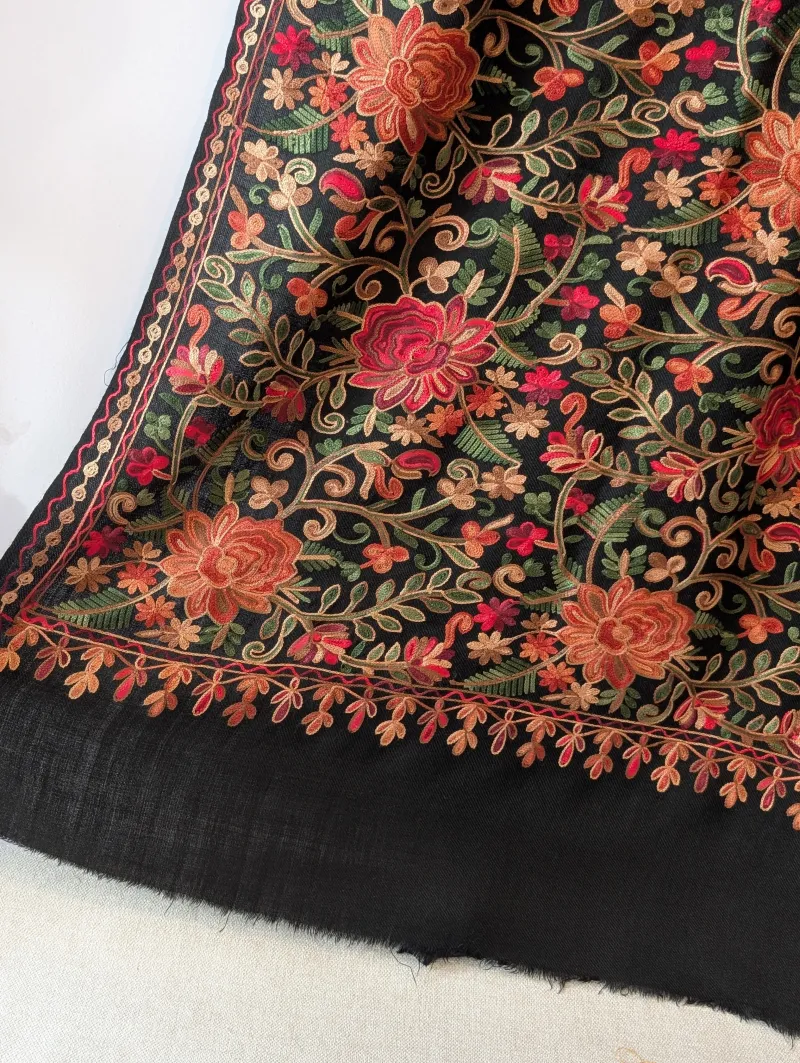
Photo: luxury Kashmiri shawl embroidery pashmina collection detail, via pakistanhandicrafts.com
The language of investment is not typically applied to textiles. Wall Street's vocabulary — appreciation, rarity premium, provenance documentation, market liquidity — belongs, in most minds, to equities, real estate, and perhaps fine art. Yet a growing number of American collectors, many of them already versed in the acquisition of paintings, jewelry, and vintage wine, have begun to apply precisely this framework to Kashmiri textiles. Their reasoning is both aesthetic and financial, and it is increasingly well-supported by market evidence.
Authentic Kashmiri pieces — defined by verifiable origin, master craftsmanship, rare materials, and documented history — have demonstrated consistent value retention and, in notable cases, significant appreciation over time. Understanding why requires an education in what separates an investment-grade Kashmiri textile from a decorative import, and that education begins with a clear-eyed examination of scarcity.
Why Scarcity Drives Value
The economic foundation of any collectible market is the relationship between supply and documented demand. In Kashmiri textiles, supply constraints are structural and intensifying.
The master craftsmen capable of producing the highest-grade work — kani weavers who work from complex talim notation systems, sozni embroiderers executing single-needle thread counts exceeding 1,000 per square inch, namdah felters carrying forward centuries of compressed wool technique — number in the hundreds, not the thousands. Many are elderly. Apprenticeship pipelines, disrupted by decades of regional instability and the economic pressures of industrialization, have not kept pace with attrition.
The practical consequence is that genuinely investment-grade Kashmiri pieces are becoming rarer each year, not more abundant. A kani shawl requiring three years of a master weaver's dedicated labor is not a product that can be scaled to meet rising demand. It is, by definition, a finite object.
For collectors, this structural scarcity is not a risk factor. It is the primary value driver.
The Investment Hierarchy: Understanding Which Pieces Appreciate
Not all Kashmiri textiles are investment-grade, and part of the collector's education lies in distinguishing between categories.
Tier One: Master-Woven Kani Shawls The apex of the Kashmiri textile hierarchy, kani shawls are produced on a specialized loom using hundreds of small wooden bobbins (kanis) to interlace colored threads according to a coded pattern notation. A full-sized, complex kani shawl from a master weaver may require two to four years of continuous labor. Pieces with documented workshop provenance, intact selvedges, and complex repeat patterns in fine pashmina have realized prices at international auction that dwarf their original acquisition cost. These are the pieces most directly analogous to significant works on paper in the fine art market.
Tier Two: Sozni Embroidered Pashmina Hand-embroidered pashmina shawls executed in the sozni style — single-needle embroidery producing designs visible on both sides of the fabric — represent a significant investment category. The distinguishing marker of top-tier sozni work is dorukha quality: a finish so precise that the textile is reversible, with no visible stitch backs. Museum-quality dorukha pieces in fine pashmina with traditional floral or buta motifs have demonstrated consistent demand among serious collectors.
Tier Three: Antique and Documented Rugs Kashmiri hand-knotted rugs with verifiable age, natural dye palettes, and documented provenance occupy a well-established position in the broader Oriental rug market. Pieces with auction history, exhibition records, or prior collection association carry the strongest investment credentials. Age alone is insufficient; condition, dye integrity, and knot density per square inch are the technical metrics that determine tier placement.
Tier Four: Contemporary Workshop Pieces with Certification Even within the contemporary market, pieces produced by named master craftsmen in certified workshops, accompanied by documentation of materials and technique, represent a legitimate entry point for collectors building long-term positions. The key differentiator is traceability: who made it, where, from what materials, and under what conditions.
Authentication: The Collector's Essential Discipline
The single greatest risk in the Kashmiri textile market is misattribution — the acquisition of machine-made or hybrid pieces represented as fully handmade. This is not a marginal concern. The market for imitation Kashmiri goods is substantial, and the visual differences between a genuine kani weave and a jacquard-loom reproduction are not immediately apparent to the uninitiated.
Several authentication protocols are worth establishing as non-negotiable practice.
Request magnification examination. Under magnification, hand-knotted and hand-woven work reveals the characteristic irregularities of human execution — slight variations in knot tension, subtle thread direction changes — that machine production cannot replicate. A jeweler's loupe is a useful field tool.
Examine the reverse. In genuine sozni embroidery, the back of the textile reveals the thread path of each stitch. In printed or machine-embroidered approximations, the reverse shows a fundamentally different structure. Learning to read the back of a shawl is one of the most reliable authentication skills a collector can develop.
Verify fiber content. Genuine pashmina — fiber from the Capra hircus goat, averaging 12 to 16 microns in diameter — can be verified through burn testing (it burns like human hair, producing an ash that crumbles) and, definitively, through laboratory fiber analysis. Any seller of investment-grade pashmina should be able to provide fiber certification.
Seek provenance documentation. As with fine art, documented history adds value. Prior collection association, exhibition records, auction catalogues, and workshop certificates all contribute to the provenance chain that underpins long-term value.
Regional Variation and Its Significance
Within the broader category of Kashmiri textiles, regional and workshop-specific variation has meaningful implications for collectors. Pieces associated with specific valley towns — Srinagar, Kanihama, Kishtwar — carry distinct technical traditions that knowledgeable buyers can identify and that the market prices accordingly. Kanihama, for instance, is historically associated with the finest kani weaving, and pieces traceable to that tradition command a premium over geographically ambiguous alternatives.
Understanding these regional distinctions is part of what separates a sophisticated collector from a casual buyer. It requires sustained engagement with the tradition — reading, visiting, building relationships with specialists — but it is precisely this depth of knowledge that protects against overpaying and positions the collector to recognize exceptional pieces when they appear.
Building a Collection with Intention
For the American collector approaching Kashmiri textiles as a long-term asset class, several strategic principles apply.
Acquire depth before breadth. A single museum-quality kani shawl with impeccable provenance will outperform a dozen decorative pieces in both cultural and financial terms. Resist the temptation to accumulate broadly before developing the discernment to acquire selectively.
Document everything from the point of acquisition. Establish a collection record for each piece that includes purchase date, seller information, any available workshop or provenance documentation, photographs under multiple lighting conditions, and fiber or dye analysis where applicable. This documentation is the foundation of future value.
Consider storage and conservation. Investment-grade textiles require appropriate storage — acid-free tissue, controlled humidity, protection from light and pests. The cost of proper conservation is negligible relative to the value it protects.
Engage with the specialist community. Auction house textile specialists, museum curators with South Asian collections, and established dealers in traditional Kashmiri craft are the primary sources of market intelligence. Building relationships within this community accelerates the collector's education and provides access to pieces that rarely reach the open market.
The Dual Return
What distinguishes Kashmiri textiles from most alternative investment categories is the nature of the return they offer. A position in a commodity fund provides financial exposure but no sensory experience. A master-woven kani shawl, draped across a reading chair or displayed against a neutral wall, delivers both the prospect of financial appreciation and the daily presence of one of humanity's most extraordinary craft achievements.
For the American collector who values the integration of beauty and intelligence in the objects they choose to own, this dual return — aesthetic and financial, immediate and long-term — is perhaps the most compelling argument of all. Kashmir's finest textiles do not merely hold value. They embody it, visibly and tangibly, in every thread.