A Language in Silk and Wool: Decoding the Sacred Symbols of Kashmiri Textile Design
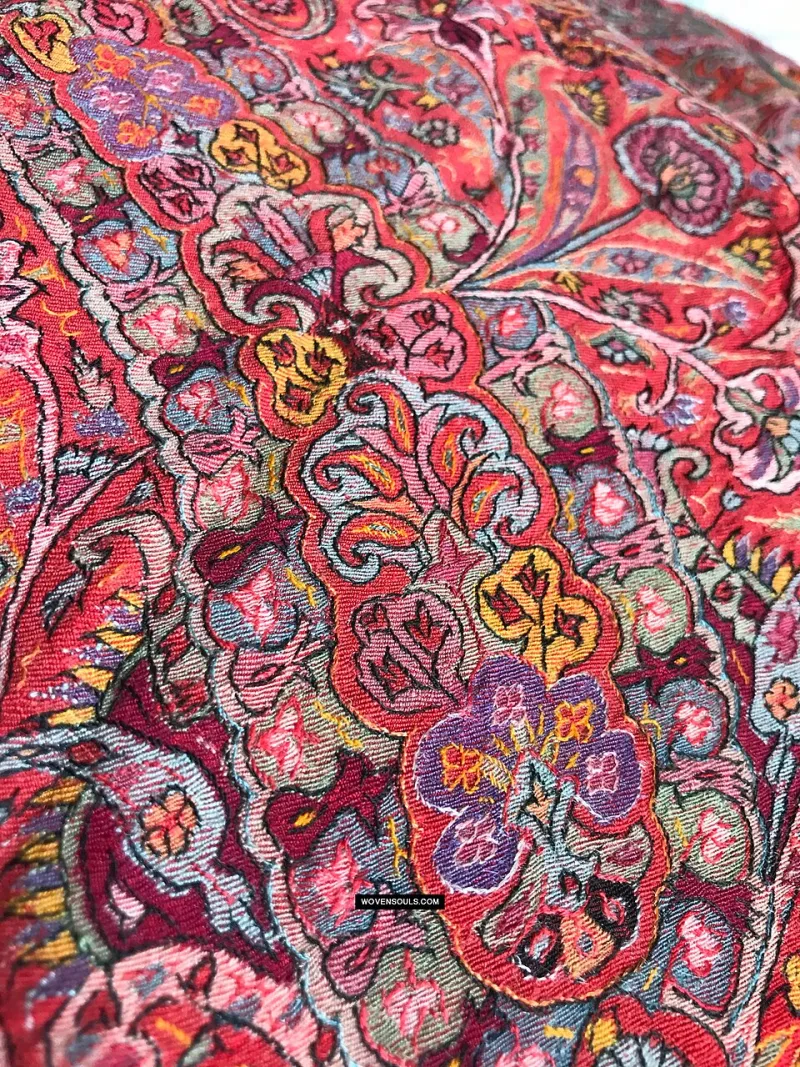
Photo: Jainamishra, CC BY-SA 4.0, via Wikimedia Commons
Consider the shawl folded in the corner of a New England antique shop, its surface alive with curving botanical forms in saffron and indigo. To the untrained eye, it is simply gorgeous. To the collector who has learned to read its visual grammar, it is something far richer: a document of trade routes, spiritual beliefs, royal patronage, and regional identity, rendered in silk and pashmina by hands that understood each motif as a word in a language older than any living speaker.
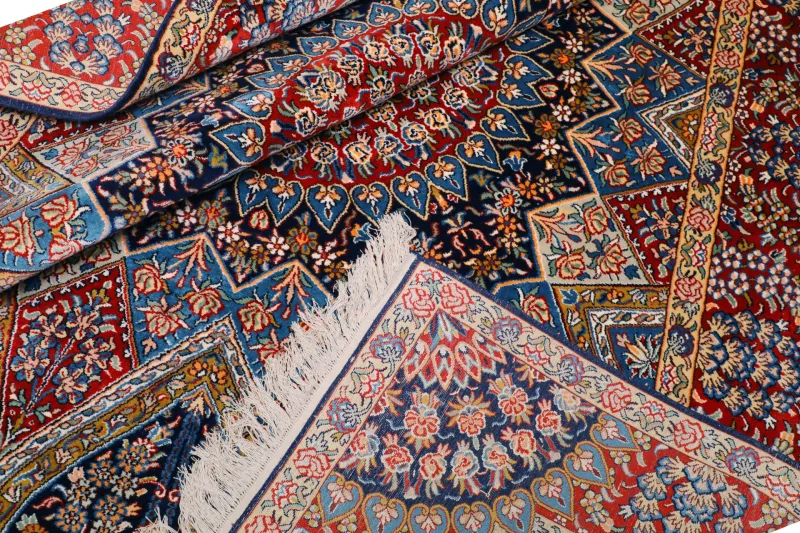
Kashmiri textiles — whether the iconic kani shawl, the hand-knotted namdah carpet, or the needle-embroidered sozni panel — operate within a sophisticated symbolic vocabulary that has evolved over centuries through the confluence of Mughal court aesthetics, Sufi mystical traditions, Persian artistic influence, and the indigenous visual culture of the Kashmir Valley. For American collectors building meaningful acquisitions, fluency in this language is not merely an intellectual pleasure. It is a practical tool for authentication, selection, and the deepest form of appreciation.
The Paisley: Not What You Think It Is
No motif is more immediately associated with Kashmiri textiles in the Western imagination than the teardrop-shaped form the English language calls "paisley" — a name derived, somewhat ironically, from the Scottish town where imitation versions were mass-produced during the nineteenth century. In Kashmir, this form has an entirely different identity and a far more complex history.
The original Kashmiri term is buta or boteh, and its visual origins are genuinely contested among textile historians. Proposed sources range from a bent cypress tree (a Persian symbol of resilience and eternal life) to the Zoroastrian flame, to a formalized representation of a mango — a fruit of considerable cultural and spiritual significance across South Asia. What all serious scholars agree upon is that the buta is not merely decorative. Its orientation, scale, density, and the specific botanical elements incorporated within its curved body all carry meaning.
A buta rendered with a pronounced inward curve at the tip traditionally signals royal or courtly provenance — the form was formalized under Mughal patronage, and its most refined iterations appear in pieces made for aristocratic clients. A buta filled with intricate hashia (border) detailing in a contrasting color palette indicates a weaver working within the high kani tradition, where complexity of internal design was a direct measure of the craftsman's status.
For collectors examining a piece, the internal composition of the buta is frequently more revealing than its outer silhouette. Authentic antique and high-quality contemporary pieces will show botanical elements — stylized flowers, leaves, and tendrils — rendered with the slight irregularities of hand-work. Mechanically produced imitations tend toward a synthetic uniformity that, once seen, is unmistakable.
The Chinar: Kashmir's Arboreal Soul
If the buta is Kashmir's most internationally recognized motif, the chinar leaf is arguably its most emotionally resonant. The Oriental plane tree — known locally as boonyi — is so deeply woven into Kashmiri cultural identity that its five-pointed leaf appears across virtually every decorative medium the region produces: carved walnut furniture, papier-mâché lacquerware, copper samovar decoration, and, with particular frequency, in the border treatments and field designs of both woven and embroidered textiles.
The chinar carries layered symbolic weight. Its autumn transformation — the leaves turning from green through gold to deep crimson before falling — has made it a potent emblem of impermanence and the beauty of transience in Kashmiri poetry and visual culture. In Sufi interpretive traditions that have profoundly shaped Kashmiri artistic sensibility, this cycle resonates with mystical themes of the soul's journey. A carpet or shawl incorporating prominent chinar motifs is, in this reading, not merely a botanical reference. It is a meditation on time.
From a practical collector's standpoint, the chinar leaf is also a useful marker of regional authenticity. Its specific five-lobed form, rendered with the naturalistic confidence of a craftsperson who has grown up under these trees, differs subtly but distinctly from the generic leaf forms that appear in pan-South Asian textile traditions.
Floral Registers and the Mughal Garden
The broader floral vocabulary of Kashmiri textiles — the narcissus (nargis), the iris (mazari), the lotus (padam), the rose (gulab), and the tulip (laleh) — traces its formal origins to the char bagh, the paradise garden of Mughal architectural and artistic imagination. When the Emperor Jahangir famously declared Kashmir "a garden of eternal spring" in his memoirs, he was articulating an aesthetic program that would shape the region's craft traditions for generations.
Each flower in the Kashmiri floral register carries specific associations. The narcissus, appearing with particular frequency in sozni embroidery, is linked in Persian and Kashmiri poetic tradition to the beloved's eye — a motif of longing and beauty. The lotus, appearing frequently in carpet borders and as a central medallion element, carries its pan-Asian significance of spiritual purity and transcendence. The tulip, introduced through Persian influence, is associated in Sufi symbolism with the divine fire — the cup-shaped bloom understood as a vessel for sacred intoxication.
When examining a piece for acquisition, the specific flowers rendered and their compositional relationships offer genuine insight into both the period of production and the intended market. Pieces produced for Mughal court consumption tend toward a more formal, symmetrical floral arrangement. Those made for broader trade — particularly the shawls produced in enormous quantities for the European market during the eighteenth and nineteenth centuries — often show a more exuberant, asymmetric composition that reflects the weaver's interpretation of Western floral preferences filtered through a Kashmiri visual sensibility.
Geometric Borders and the Architecture of Meaning
Beyond the primary field designs, the border systems of Kashmiri carpets and shawls constitute their own symbolic register. The hashia (outer border), khana (inner border), and zanjeer (chain border) are not merely frames. They are structural arguments about the relationship between center and periphery, the sacred and the quotidian.
Running vine patterns — called islimi in the Persian-influenced tradition — suggest continuity and the interconnectedness of all living things. Geometric meander borders, appearing frequently in carpet work, echo architectural forms found in Kashmiri mosque design, creating a visual link between domestic and sacred space. For the collector placing a Kashmiri carpet in an American home, this architectural resonance is worth sitting with: the object was designed, at some level, to make a room feel like a considered place.
Reading Before Buying
Developing fluency in Kashmiri textile symbolism is ultimately a practice, not a destination. Each piece encountered adds vocabulary. Each motif traced and identified deepens the collector's ability to distinguish the authentic from the approximate, the exceptional from the merely competent.
The most practical advice for American collectors approaching this material is simply to look slowly — which is, perhaps, the most Kashmiri instruction imaginable. The symbols do not announce themselves. They reward patience, attention, and the willingness to learn a language that has been in continuous development for four hundred years. The shawl on the antique shop shelf is waiting to tell you something. The question is whether you are ready to listen.