Sacred Threads in New Spaces: The Ethics and Elegance of Collecting Kashmir's Ceremonial Textiles
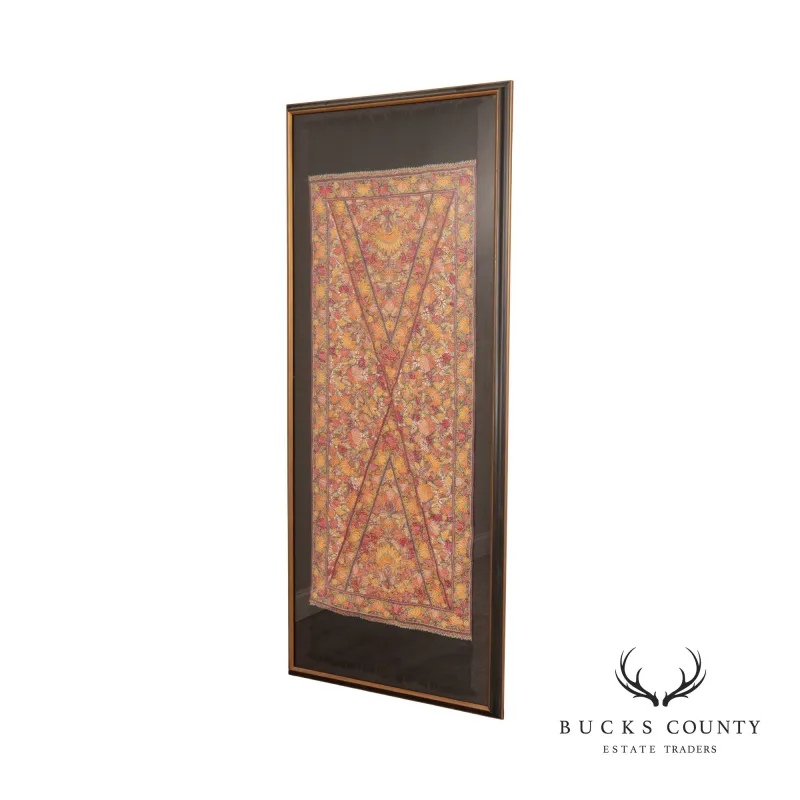
Photo: framed embroidered Kashmiri shawl displayed on wall contemporary home interior, via store.buckscountyestatetraders.com
There is a particular kind of silence that surrounds certain objects — a quality of accumulated significance that makes itself felt even before one understands its source. Visitors to the homes of serious Kashmiri textile collectors frequently describe this experience: standing before a mounted shawl or a framed fragment of embroidery, sensing that the object carries a history far exceeding its visual beauty, and feeling the particular weight of not quite knowing what that history is.
That not-quite-knowing is, for many collectors, the beginning of a more serious engagement. And it is worth examining carefully.
Objects With Original Lives
To understand what is at stake in the American collecting of traditional Kashmiri ceremonial textiles, one must first understand what these objects originally were — and what they meant to the families who commissioned, received, and preserved them across generations.
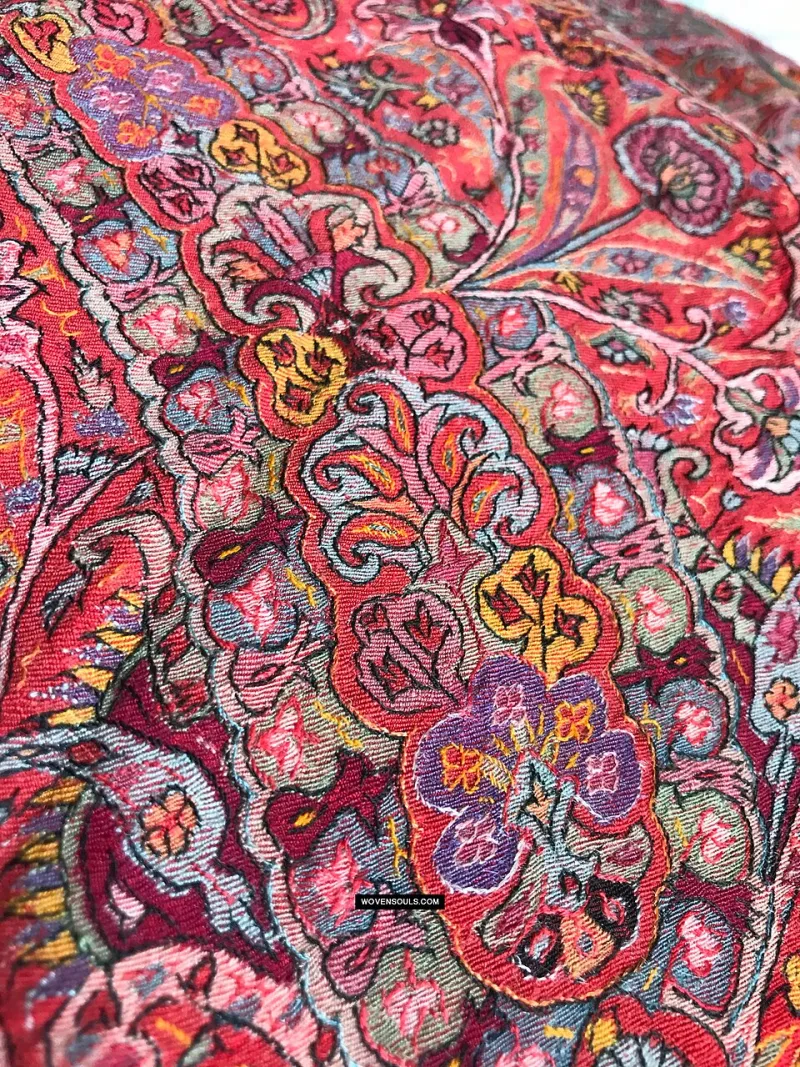
In Kashmiri tradition, the finest handwoven and embroidered textiles were not decorative commodities. They were participants in the most significant moments of family life. A heavily embroidered sozni shawl, worked with the dense floral patterns known as jamawar, might have been commissioned years in advance of a daughter's wedding, its completion timed to coincide with her marriage and its presentation understood as a transfer of both material wealth and maternal blessing. A hand-knotted carpet, knotted to a specific size for a specific room in a specific home, carried within its dimensions the intention of a family establishing itself in a place.
These objects moved through time within families. They were brought out for celebrations, stored carefully between occasions, repaired when necessary, and eventually passed to the next generation as tangible evidence of lineage and continuity. Their value was never purely aesthetic. It was relational — inseparable from the people who made them, gave them, and received them.
When such pieces enter the Western antiques and collectibles market — as they increasingly do, through estate sales, auction houses, and specialist dealers — they arrive stripped of that relational context. The collector who acquires them inherits the object but not the story.
How American Collectors Are Responding
The American collectors who are most thoughtfully engaging with Kashmir's ceremonial textiles tend to be acutely aware of this gap — and are developing increasingly sophisticated approaches to bridging it.
In Washington, D.C., one collector of South Asian art has spent more than a decade assembling a collection of antique Kashmiri shawls that she displays throughout her home, each accompanied by a handwritten card noting its approximate period of production, the technique involved, and whatever provenance information she has been able to reconstruct. She describes the research process as inseparable from the collecting itself. "I don't feel I've fully acquired a piece until I understand something of where it came from," she has said. "The textile is the beginning of the inquiry, not the end of it."
This orientation — treating the object as a prompt for deeper cultural learning rather than simply a beautiful thing to possess — is increasingly common among collectors who take Kashmir's craft traditions seriously. It reflects a broader evolution in American collecting culture, one that has moved away from the purely acquisitive model toward something more akin to stewardship.
In practice, this stewardship takes many forms. Some collectors maintain ongoing relationships with Kashmiri cultural organizations, contributing to documentation and preservation efforts. Others commission contemporary pieces from master artisans specifically to support living craft traditions, displaying antique and contemporary works in deliberate dialogue. Still others prioritize acquiring pieces directly from Kashmiri families or artisan cooperatives, ensuring that value flows back to the community from which the textiles originate.
The Display Question
Perhaps no aspect of this collecting practice generates more nuanced discussion than the question of how ceremonial textiles should be displayed in American homes — and whether the act of framing a shawl as wall art fundamentally transforms its nature.
Kashmiri cultural scholars hold a range of views on this question, and their perspectives deserve serious attention. Some argue that the recontextualization of a ceremonial textile as a displayed art object represents a form of cultural misappropriation — that removing an item from its intended ceremonial function and placing it in a Western interior, however respectfully, severs it from the meaning that justified its existence. The object becomes, in this reading, a beautiful husk.
Others take a more accommodating position, suggesting that the alternative — these pieces disappearing into private storage or deteriorating without proper care — serves no one's interests, least of all those of Kashmiri craft traditions. Display, in this view, is a form of advocacy: every visitor who stands before a mounted jamawar shawl and asks about its origin is a potential supporter of the living traditions that produced it.
Between these positions lies a range of practices that most thoughtful collectors are navigating in real time. The consensus that appears to be emerging — at least among those most deeply engaged with the question — is that display is neither inherently respectful nor inherently problematic. What determines its ethical character is the framework of knowledge, acknowledgment, and ongoing relationship within which it occurs.
Designing With Intention
For those approaching the question from a primarily aesthetic direction — collectors who are drawn first to the visual power of Kashmiri textiles and are developing their cultural understanding alongside their eye — there are practical principles that experienced designers and collectors have found useful.
Primary among them is the principle of restraint. A single significant Kashmiri textile, displayed with space and light sufficient to honor its complexity, commands far more attention — and communicates far more respect — than a room crowded with multiple pieces competing for prominence. The best interiors built around ceremonial textiles treat each piece as the focal point it deserves to be.
Contextual framing matters enormously as well. A brief, accurate, and honest account of a textile's origin and significance — whether on a small label, in a coffee table book left nearby, or simply in the collector's ability to speak knowledgeably about it when asked — transforms the viewing experience for guests and signals the seriousness with which the collector regards what they have acquired.
Finally, there is the question of condition and conservation. Antique textiles displayed as art require the same environmental considerations as any fragile work on paper or canvas: controlled light levels, stable humidity, and periodic consultation with a textile conservator. The commitment to proper stewardship is, in itself, a form of respect for the object's origins.
A Living Conversation
What is perhaps most striking about the American collectors who are engaging most thoughtfully with Kashmir's ceremonial textiles is their consistent description of the practice as an ongoing conversation rather than a completed acquisition. They speak of pieces that continue to reveal themselves over time, of questions that one object raises that send them toward another, of relationships with Kashmiri craftspeople and scholars that have deepened their understanding in ways that no amount of independent research could replicate.
This is, in the end, what distinguishes genuine collecting from mere accumulation. The object on the wall is not a destination. It is a point of connection — between an American home and a Himalayan valley, between a contemporary interior and centuries of accumulated skill, between the person who made something and the person who is now, in their own way, responsible for it.
Handled with the care it deserves, that connection is not a diminishment of the textile's original meaning. It is, arguably, an extension of it — proof that beauty made with full intention continues to find its way toward people capable of receiving it.