The Signature in the Flaw: How Kashmiri Textile Imperfections Reveal the Hand Behind the Work
There is a moment, familiar to many first-time collectors of Kashmiri textiles, when the eye catches something unexpected. Perhaps it is a slight drift in the repeat of a paisley motif across a kani shawl, or a thread that carries a marginally deeper hue than its neighbors, or a border whose width narrows by a fraction of a centimeter at one corner. The instinct, shaped by decades of shopping in a culture that prizes uniformity, is to read this as error. To wonder, briefly, whether the piece is somehow lesser.
That instinct, once examined and set aside, opens the door to a far richer understanding of what Kashmiri craftsmanship actually is — and what it asks of the people who collect it.
Precision Redefined
The Western luxury market has long conflated perfection with precision, and precision with machines. A Swiss watch movement, a seamlessly welded automobile chassis, a bolt of fabric produced on an industrial loom — these objects derive their prestige partly from the absolute absence of variation. Every unit is identical. Every measurement is repeatable to a tolerance measured in microns.
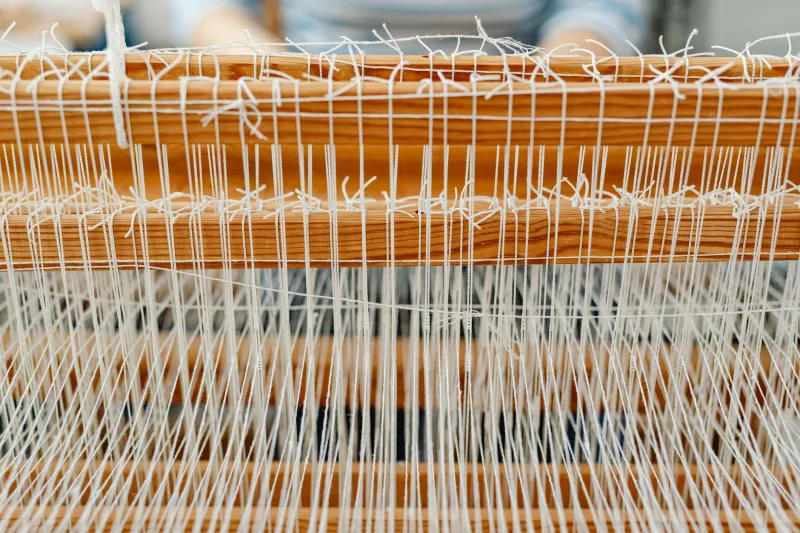
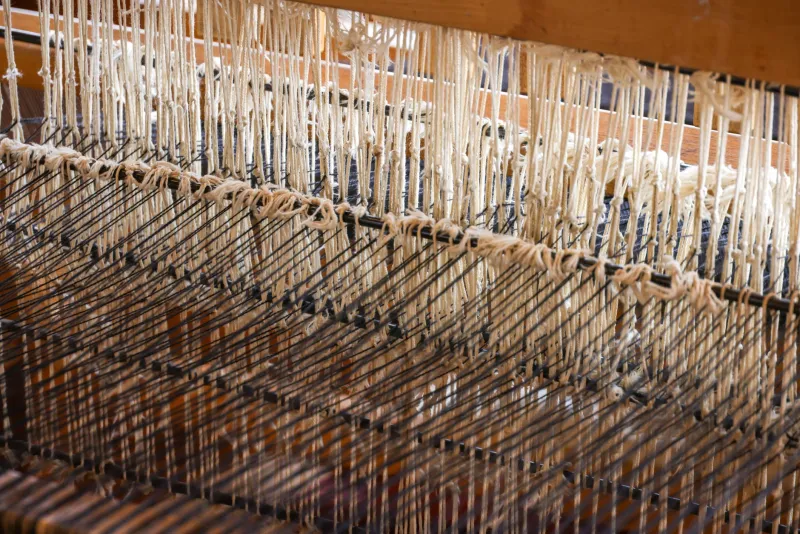
Handmade Kashmiri textiles operate under an entirely different logic. A master weaver working at a traditional kani loom in the villages outside Srinagar does not have access to a computerized repeat function. A sozni embroiderer guiding a fine needle through pashmina is not following a digitally projected template. These artisans carry their patterns in memory, in muscle, in the accumulated intelligence of years of practice — and that intelligence, however extraordinary, belongs to a human being rather than a machine.
The result is a textile that breathes. Its symmetry is approximate rather than absolute. Its colors shift subtly across the field as dye lots vary and as the light in the workshop changes hour by hour. Its proportions are governed by hand and eye rather than by calibrated instruments. These are not the qualities of a flawed product. They are the qualities of a living one.
What the Irregularities Actually Record
To understand why subtle variations matter, it helps to consider what they document. Each slight deviation in a piece of handwoven or hand-embroidered Kashmiri work is, in the most literal sense, a record of a specific human moment. The fractional shift in thread tension along one edge of a shawl may reflect the way an artisan adjusted his posture on a particular afternoon. The minor color variation in a border may mark the point at which a new batch of hand-spun yarn was introduced. The gentle asymmetry in a central medallion may record the natural drift of a craftsperson's dominant hand across a long session of focused work.
These are not accidents. They are data. And for a collector who knows how to read them, they transform a textile from a decorative object into a document — evidence of a specific person, working in a specific tradition, at a specific moment in time.
This is precisely the quality that machine production cannot replicate, no matter how sophisticated it becomes. A loom guided by a digital Jacquard mechanism can produce a pattern of extraordinary complexity, but it cannot produce a pattern that carries the record of human presence. That distinction is absolute.
The Education of the American Eye
American collectors, by and large, arrive at Kashmiri textiles with eyes trained on uniformity. The retail environments most of us grew up navigating — department stores, big-box retailers, e-commerce platforms — reward consistency and penalize variation. A shirt with one sleeve marginally longer than the other is a defect. A rug whose pattern shifts slightly across its width is a quality-control failure.
Unlearning this framework is one of the central tasks of becoming a serious collector of handmade work. It requires a deliberate shift in the criteria by which quality is assessed — away from the question of whether a piece matches an ideal template, and toward the question of whether a piece bears the evidence of skilled human labor.
Many collectors describe this shift as one of the most rewarding aspects of building a Kashmiri collection. Once the eye has learned to read variation as information rather than error, the entire experience of handling a fine shawl or an embroidered table covering changes. What once seemed like imperfection begins to read as intimacy — a form of closeness to the maker that no machine-produced object can offer.
Distinguishing Meaningful Variation from Genuine Defect
It is worth being clear about a distinction that sometimes causes confusion: not every irregularity in a Kashmiri textile is a mark of mastery. There is a meaningful difference between the subtle, organic variation that characterizes genuine handcraft and the kind of careless inconsistency that reflects poor technique or rushed production.
Authentic variation tends to be small in scale and consistent in character. A slight drift in pattern repeat across a large kani shawl is expected and natural. A dramatic misalignment in a central motif, or a section of embroidery where the stitches are visibly uneven in a way that suggests inattention rather than the rhythm of sustained work, may warrant closer scrutiny.
The collector's eye, developed over time and through handling many pieces, learns to make these distinctions intuitively. Reputable dealers and auction specialists can also help contextualize what a given variation means within the tradition from which a piece comes. The goal is not to celebrate every flaw indiscriminately, but to recognize the difference between the organic signature of a skilled hand and the marks of work that falls short of its own tradition's standards.
A Different Grammar of Luxury
There is a broader cultural conversation embedded in this discussion, one that extends well beyond the Kashmiri textile market specifically. As American consumers become increasingly aware of the environmental and human costs of mass production, and as interest in artisan-made goods continues to grow, the question of how we define quality is being revisited across many categories.
Kashmiri textiles offer one of the most compelling available arguments for a luxury grammar built on human presence rather than mechanical consistency. A pashmina shawl that took a master weaver four months to produce is not valuable despite its minor irregularities. It is valuable, in part, because of them — because they confirm that a human being gave months of focused attention to its creation, and that no shortcut was taken.
This is the understanding that distinguishes a collector from a consumer. The consumer seeks the object that most closely resembles the ideal image. The collector seeks the object that most fully embodies the process that produced it — and recognizes that in handmade Kashmiri work, those two things are inseparable.
The flaw, read correctly, is not a diminishment. It is the signature.